
Business Insurance
New York Commercial Electrician Insurance
★★★★★ 150+ Five-Star Reviews · Google & Facebook
Running an electrical contracting business in New York is not for the faint of heart. Between the state's aggressive litigation environment, strict licensing requirements, and some of the highest insurance premiums in the country, getting your coverage right isn't optional - it's survival. General liability premiums alone for New York electricians run 150% to 300% higher than the national average, largely because of the state's Labor Law Sections 240 and 241, which impose near-absolute liability on contractors for gravity-related injuries on construction sites. If you're a commercial electrician operating in this state, understanding your insurance needs, the licensing compliance landscape, and which carriers actually want your business is the difference between building something lasting and getting wiped out by a single claim.
Essential Insurance Policies for NY Commercial Electricians
New York's legal environment creates a uniquely hostile claims landscape for electrical contractors. The coverage stack you need here looks different from what works in most other states, and getting it wrong can cost you everything.
General Liability and the NY Action Over Exclusion
General liability is the foundation of every contractor's insurance program, but in New York, there's a critical wrinkle most out-of-state agents miss: the Action Over Exclusion. Here's how it works. When an employee gets injured on a jobsite, workers' comp typically covers the claim and prevents the employee from suing their employer directly. But New York's Labor Law allows that injured worker to sue the general contractor or property owner, who then turns around and sues your company for contribution or indemnification. That's the "action over" claim, and many standard GL policies exclude it.
You need an endorsement that specifically covers action over claims, or you're carrying a massive gap in your protection. This is one of the most common coverage mistakes we see New York electrical contractors make. A single scaffold fall or ladder incident can trigger a Labor Law 240 claim worth millions, and if your GL policy has an unendorsed action over exclusion, you're funding that defense out of pocket.
Standard GL limits of $1M per occurrence and $2M aggregate are the minimum. Most general contractors in New York City won't let you on a jobsite without at least those limits, and many require $5M or more when you factor in umbrella requirements.
Professional Liability for Electrical Design and Consulting
If your firm does any design-build work, value engineering, or consulting on electrical systems, you need professional liability (errors and omissions) coverage. Standard GL policies exclude claims arising from professional services, so a design flaw in a commercial electrical system that causes a fire or equipment failure won't be covered under your general liability.
This coverage is especially relevant for contractors working on complex commercial projects: data centers, hospital power systems, or industrial facilities where a design error can cascade into catastrophic losses. Premiums vary widely based on your project types and revenue, but expect to pay $3,000 to $15,000 annually for meaningful limits.
Commercial Umbrella and Excess Liability Requirements
Most commercial project contracts in New York require umbrella limits of $5M to $10M, and high-rise or public infrastructure work can push that to $25M or more. An umbrella policy sits above your GL, auto, and employers' liability, providing additional limits when underlying policies are exhausted.
The catch is that not every umbrella policy is created equal. Some exclude certain claim types or don't follow form with your underlying coverage. A specialty program like Joule Pro, built specifically for electrical contractors, can match umbrella coverage to the actual risks you face on commercial jobsites rather than forcing you into a generic policy with hidden gaps.

By: Michael Fusco
President of Joule Pro
INDEX
Joule Pro is a specialty insurance and risk program of Fusco Orsini & Associates Insurance Services, built exclusively for electrical contractors and licensed in 31 states.
We work with electrical firms across the country — from California, Texas, Florida, New York, and coast to coast — placing General Liability, Workers' Compensation, Commercial Auto, Inland Marine, Surety Bonds, Excess Liability, and full specialty coverage stacks for commercial, industrial, service, residential, and low-voltage electrical contractors. Joule Pro is not a separate licensed entity. It is a dedicated program structure inside Fusco Orsini, giving electrical contractors access to specialty carriers, in-house claims advocacy, and trade-specific risk engineering under one program.
Navigating New York State Licensing and Compliance
New York has some of the most complex licensing and insurance compliance requirements in the country. Missing a single requirement can result in fines, license suspension, or inability to pull permits.
Master Electrician License Insurance Requirements
New York City requires a Master Electrician License issued by the Department of Buildings for anyone performing electrical work. To obtain and maintain this license, you must carry specific insurance minimums, including general liability and workers' compensation. The city periodically audits licensees for compliance, and lapses in coverage can trigger license suspension.
Outside NYC, requirements vary by municipality. Westchester, Nassau, and Suffolk counties each have their own licensing boards with different insurance thresholds. If you work across multiple jurisdictions, you need a coverage program flexible enough to meet the strictest requirements everywhere you operate.
| Coverage Type | NYC Minimum | Typical Contract Requirement |
|---|---|---|
| General Liability | $1M/$2M | $2M/$4M or higher |
| Workers' Compensation | Statutory | Statutory |
| GL Minimum | $1M CSL | $1M CSL |
| Umbrella/Excess | Not required by law | $5M-$10M typical |
| Disability Benefits | Statutory (DBL) | Statutory (DBL) |
Workers' Compensation and Disability Benefits Law Compliance
New York is one of the strictest states for workers' comp enforcement. Every employer must carry coverage - no exceptions, no minimum employee thresholds. The state also requires Disability Benefits Law (DBL) coverage, which provides partial wage replacement for off-the-job injuries and illnesses. Both policies must be in place before you hire your first employee.
New York's workers' comp rates for electricians are classified under codes like 5190 (electrical wiring) and carry base rates that reflect the state's high medical costs and generous benefit structure. Experience modification rates (EMR) play a huge role in your premium. An EMR above 1.0 signals worse-than-average loss history and can increase your premium by 20% to 50% or more. Keeping your EMR low through safety programs and prompt claims management is one of the most effective ways to control costs.
Trade-Specific Risks in High-Voltage Commercial Projects
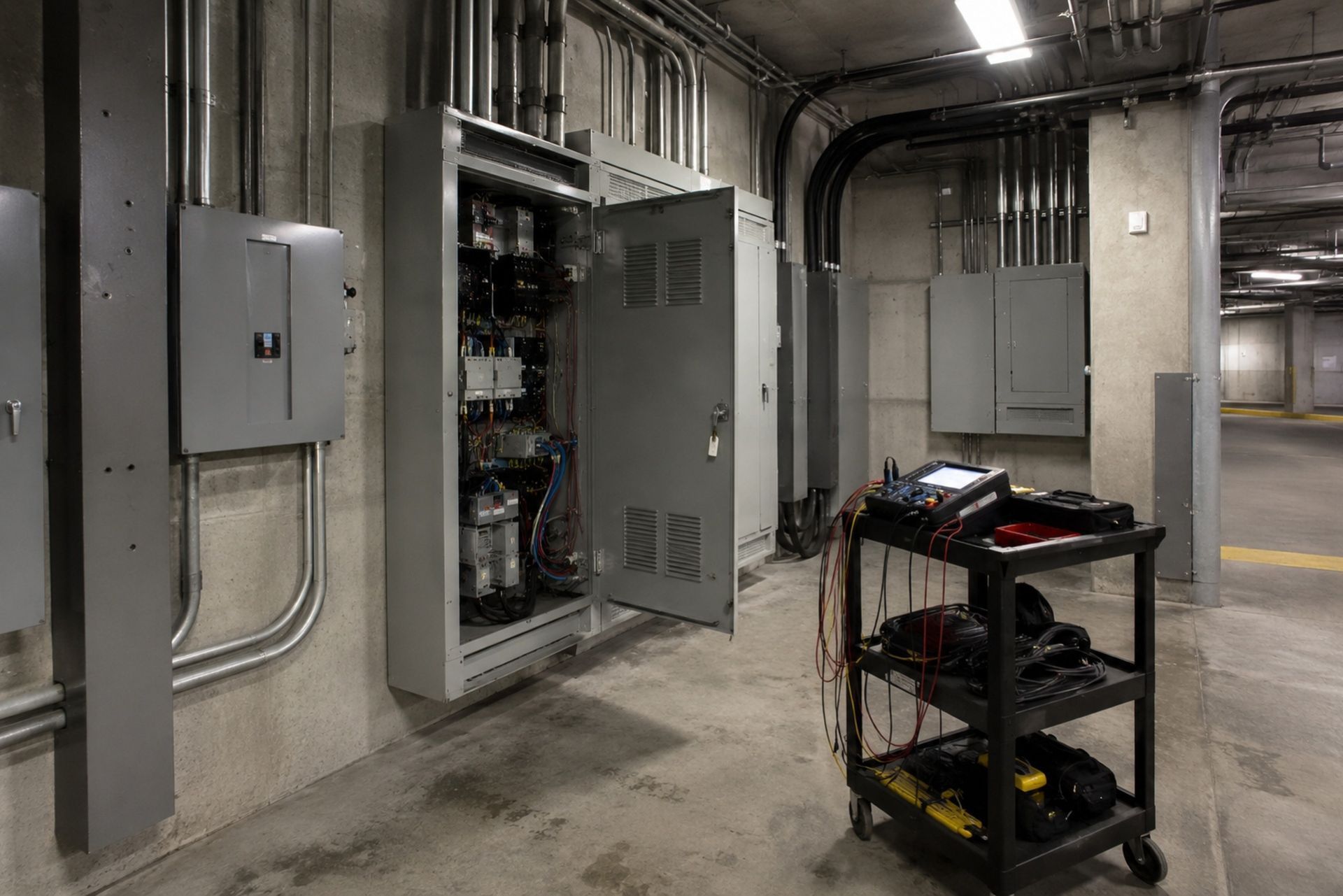
Commercial electrical work carries inherent hazards that generic contractor policies don't always address. Understanding these risks helps you identify where standard coverage falls short.
Equipment Breakdown and Inland Marine Coverage
Your tools and equipment are your livelihood. A standard commercial property policy often excludes tools in transit or stored at jobsites. Inland marine coverage - sometimes called a contractor's equipment floater - protects your wire pullers, conduit benders, testing instruments, and other specialized gear wherever they go.
Equipment breakdown coverage is a separate consideration. If you install or maintain switchgear, transformers, or generators, a mechanical or electrical failure in equipment you've installed can trigger claims that fall outside standard GL territory. This coverage fills that gap. Joule Pro's contractor-specific program includes inland marine and tools coverage designed for the equipment electrical contractors actually use, not a one-size-fits-all property endorsement.
Completed Operations and Faulty Workmanship Issues
Here's a scenario that plays out more often than you'd think: your crew finishes wiring a commercial kitchen, passes inspection, and moves on. Six months later, a connection fails, causes an arc flash, and damages $200,000 worth of equipment. The building owner's attorney comes after you.
Completed operations coverage under your GL policy handles claims arising from work you've already finished. But some policies limit or sublimit completed operations, especially for electrical contractors. Faulty workmanship claims are particularly tricky because many policies cover the resulting damage but exclude the cost of repairing or replacing your own defective work. Make sure your policy's completed operations coverage has adequate limits and doesn't contain restrictive endorsements that gut protection when you need it most.
Understanding Carrier Appetite for New York Contractors
Not every insurance company wants to write commercial electrician policies in New York. The state's litigation environment, high claim severity, and regulatory complexity make many carriers cautious. Knowing which carriers have appetite for your risk saves you time and frustration.
Admitted vs. Non-Admitted Carriers in the NY Market
Admitted carriers are licensed by the New York Department of Financial Services and participate in the state's guaranty fund, which provides a backstop if the carrier becomes insolvent. Non-admitted (surplus lines) carriers operate outside this system but can offer coverage that admitted carriers won't touch.
For electrical contractors with clean loss histories and strong safety programs, admitted carriers typically offer the best pricing and stability. But if you have a high EMR, prior claims, or work in particularly hazardous specialties like high-voltage utility connections, you may need a surplus lines carrier. The tradeoff is usually higher premiums and less regulatory protection. A specialty producer with established underwriter relationships across both markets can place your risk more efficiently than a generalist agent shopping your account cold.
Risk Mitigation Strategies to Lower Premiums
Carriers reward contractors who actively manage risk. Concrete steps that move the needle on your premiums include:
- Implementing a written safety program with documented toolbox talks and incident reporting
- Maintaining OSHA 10 or OSHA 30 certifications for all field employees
- Using subcontractor qualification procedures with insurance verification
- Keeping your EMR below 1.0 through aggressive return-to-work programs
- Installing GPS and dashcams in company vehicles to reduce auto liability exposure
These aren't just checkbox items. Underwriters at specialty carriers review this information during the quoting process, and contractors who present a well-organized risk profile consistently receive better terms.
Strategic Coverage Selection for Long-Term Business Growth
Getting your insurance right in New York isn't a one-time decision. As your business grows, your risk profile changes. Taking on larger commercial projects, hiring more employees, or expanding into new service areas all require coverage adjustments.
The smartest approach is working with a producer who specializes in the electrical trade and understands New York's specific requirements. Joule Pro exists for exactly this reason: a program built exclusively for licensed electrical contractors, backed by Fusco Orsini & Associates Insurance Services, with direct access to a licensed professional who handles your quotes, binders, and policy questions personally. No self-serve portal, no generic advice.
Review your coverage annually, especially before bidding on projects that push your current limits. A $5M umbrella that worked last year might not cut it when you're bidding a $20M hospital renovation. Build your insurance program with the same care you bring to your electrical work, and it will protect you when it matters most.
Frequently Asked Questions
How much does general liability insurance cost for electricians in New York? Expect to pay $8,000 to $25,000 or more annually for $1M/$2M limits, depending on your revenue, claims history, and the types of commercial projects you handle. NYC contractors typically pay at the higher end.
Do I need professional liability if I only do installation work? If you never provide design input, formal consulting, or value engineering, you may not need it. But if you advise clients on system design or specify equipment, an E&O policy protects against claims your GL won't cover.
What happens if my workers' comp policy lapses in New York? The state can issue stop-work orders, impose penalties of $2,000 per 10-day period, and hold business owners personally liable for any injuries that occur during the lapse.
Can I get insurance with a high experience modification rate? Yes, but your options narrow significantly. Surplus lines carriers will often write contractors with EMRs above 1.3, though premiums will be substantially higher. Investing in safety improvements to bring your EMR down is the best long-term strategy.
Why do some carriers refuse to insure New York electrical contractors? New York's Labor Law 240/241 creates near-absolute liability for gravity-related injuries, driving claim severity well above national averages. Many carriers simply don't have the risk tolerance for this exposure.

Founder & CEO
The Force Behind the Program
About the Author:
Michael Fusco.
Fusco Orsini & Associates
Joule Pro exists because Mike Fusco saw electrical contractors getting boilerplate insurance — and built a program designed for the way the trade actually works.
Mike is the CEO and co-founder of Fusco Orsini & Associates, the San Diego–based independent agency he launched in 2010. Under his leadership FOA has grown into a nationwide partner serving clients across 31 states, with a personal, client-first approach to commercial insurance and risk.
With over 20 years in insurance and risk management, he specializes in tailored programs spanning general liability, workers' compensation, surety bonding, and employee benefits — helping owners confidently manage risk and pursue growth.
Mike holds a B.S. in Business from the University of Maryland — Robert H. Smith School of Business, and the Certified Insurance Counselor (CIC) designation, held by fewer than 3% of insurance professionals nationwide.
What Our Clients Say
Trusted by Electrical Contractors Across the Country.
5.0
★★★★★
Google reviews
Core Commercial Coverage
Business Insurance for Electrical Contractors.
The fundamentals — written, structured, and priced for electrical risk. Each line is reviewed annually by an underwriter who only writes our trade.
01
General Liability
Premises & completed-operations coverage with electrical-specific endorsements and full pollution carve-back options.
02
Workers' Compensation
Class-code optimization, experience-mod review, and return-to-work programs designed for energized-work exposures.
03
Commercial Auto
Fleet, hired & non-owned auto, and tools-in-transit coverage written for service vans and bucket trucks.
04
Tools & Equipment
Scheduled and blanket coverage for tools, test equipment, scissor lifts, and contractor's equipment on-site or in-transit.
05
Surety Bonds
Bid, performance, and payment bonds — single-job and aggregate programs for commercial & public-works contracts.
06
Commercial Property
Layered limits up to $50M with carrier panels covering your shop, warehouse, yard, and on-premises tools, materials, and equipment.
Who We Serve
Electrical Contractors We Specialize In.
From $5M service shops to $250M industrial primes — every Joule Pro program is shaped to the contractor's revenue mix and project profile.
01 / Industrial
Commercial & Industrial Electrical Contractors
High-voltage, substation, and plant electrical work. Pollution, builder's risk, and large-deductible WC programs.
02 / Service
Service & Residential Electrical Contractors
Service-call shops, panel upgrades, and EV charging installers. Auto-fleet, GL, and tool-coverage programs.
03 / Low-Voltage
Specialty & Low-Voltage Contractors
Data, fire-alarm, security, and BMS controls. Cyber, professional liability, and follow-form excess.
Frequently Asked Questions
Common
Questions From
Electrical Contractors.
What size electrical contractors do you write?
Joule Pro is built for licensed electrical firms from roughly $2M in revenue to $250M+. Below $2M we typically refer to our small-business desk; above $250M we underwrite individually with our industrial practice team.
Do I need to be licensed in multiple states?
No. We license you wherever you work. Joule Pro is admitted in 31 states and our compliance team handles multi-state filings, prevailing-wage endorsements, and certificate-of-insurance requirements.
How is Joule Pro different from a generic contractor program?
Generic programs use a contractor's questionnaire that treats you like a roofer. We use forms written for energized work, arc-flash exposures, and design-build risk — and our carriers price accordingly.
What does the claims process actually look like?
Every Joule Pro client is assigned a named claims advocate at bind. They take the FNOL, set strategy with your assigned attorney, and serve as your single point of contact through close.
Can you bond large public-works contracts?
Yes. Through our surety partners we write single-job bonds up to $75M and aggregate programs to $300M, with expedited turnarounds for school district, federal, and DOT work.
What happens at renewal?
Your producer and claims advocate jointly run a renewal review 90 days out — covering loss trends, exposure changes, and market alternatives — so renewal day is a confirmation, not a surprise.
From the Blog
Insights for Electrical Contractors.
Risk briefings, claim post-mortems, and program updates — written by our underwriters and risk engineers.


Get Started
Get a Quote on a Program Built Around Your Trade.
A 30-minute discovery call is the only commitment. You'll leave with a written gap analysis of your current program — yours to keep, whether you bind with us or not.