
Business Insurance
General Liability Insurance For Electricians in Indiana
★★★★★ 150+ Five-Star Reviews · Google & Facebook
Running an electrical contracting business in Indiana means dealing with real risk every single day. A misrouted wire, a client who trips over your toolbox, or a fire that starts weeks after a panel installation: these aren't hypothetical scenarios. They're the kinds of claims that can bankrupt a small shop overnight. General liability insurance for electricians in Indiana isn't just a box to check. It's the financial backbone that keeps your business standing when something goes sideways. Whether you're a one-person operation pulling permits in Fort Wayne or managing a crew across the Indianapolis metro, understanding your coverage limits, what the state actually requires, and which carriers want your business matters more than most contractors realize.
Understanding General Liability for Indiana Electrical Contractors
General liability (GL) insurance is the foundational policy for any electrical contractor. It covers third-party claims: meaning someone outside your company alleges you caused them harm or damaged their property. This is separate from workers' compensation (which covers your employees) and professional liability (which covers design errors). GL is specifically about what happens to other people and their stuff because of your work or your presence on a job site.
For Indiana electricians, the most common GL claims involve accidental property damage during a job, bodily injury to a homeowner or bystander, and damage that shows up after you've finished the work. Your policy typically covers legal defense costs too, which can easily run $50,000 or more even if a claim is ultimately dismissed.
Protecting Against Bodily Injury and Property Damage
The bread-and-butter of any GL policy is premises and operations coverage. If a homeowner steps on exposed wiring you left out during a panel upgrade, that's a bodily injury claim. If your apprentice accidentally drills through a water pipe and floods a finished basement, that's property damage. These claims happen more often than most contractors want to admit.
A standard $1M/$2M general liability policy for a small Indiana electrical business runs roughly $106 per month, which is a modest cost relative to the exposure. One water damage claim alone can exceed $20,000 before attorneys get involved. The policy pays for medical bills, repair costs, and legal fees up to your coverage limits, minus any applicable deductible.
The Role of Completed Operations Coverage
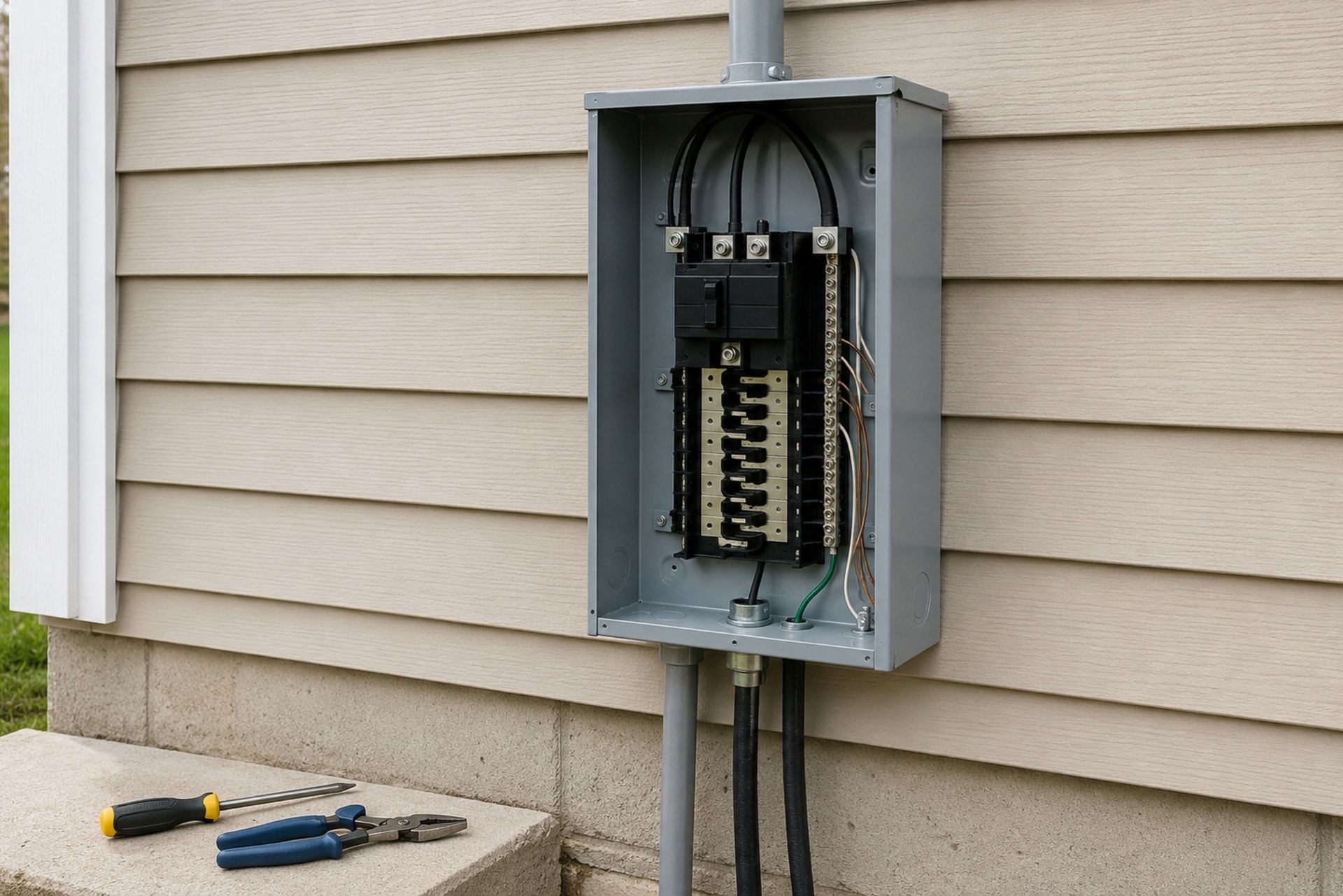
Here's where a lot of electricians get caught off guard. Completed operations coverage protects you after you've finished a job and left the site. Say you install a subpanel in a garage, and six months later a connection fails, causing an electrical fire. Without completed operations coverage, your GL policy might not respond to that claim at all.
Most standard GL policies include completed operations, but the limits and exclusions vary. Some cheaper policies exclude fire-related damage from electrical work, which is essentially useless for an electrician. Always read the completed operations section carefully, or better yet, have a specialty broker like Joule Pro review it. This is one area where the difference between a generalist policy and one designed for electrical contractors becomes painfully obvious.

By: Michael Fusco
President of Joule Pro
INDEX
Understanding General Liability for Indiana Electrical Contractors
Indiana State Requirements and Licensing Mandates
Determining Optimal Coverage Limits for Your Business
Carrier Appetite: How Insurers View Electrical Risks in Indiana
Factors Influencing Insurance Premiums for Hoosier Electricians
Strategic Tips for Securing Competitive Quotes and Comprehensive Protection
Making the Right Choice for Your Indiana Electrical Business
Joule Pro is a specialty insurance and risk program of Fusco Orsini & Associates Insurance Services, built exclusively for electrical contractors and licensed in 31 states.
We work with electrical firms across the country — from California, Texas, Florida, New York, and coast to coast — placing General Liability, Workers' Compensation, Commercial Auto, Inland Marine, Surety Bonds, Excess Liability, and full specialty coverage stacks for commercial, industrial, service, residential, and low-voltage electrical contractors. Joule Pro is not a separate licensed entity. It is a dedicated program structure inside Fusco Orsini, giving electrical contractors access to specialty carriers, in-house claims advocacy, and trade-specific risk engineering under one program.
Indiana State Requirements and Licensing Mandates
Indiana doesn't have a single statewide mandate requiring all electricians to carry general liability insurance. The state's licensing structure operates at both the state and local level, which creates a patchwork of requirements depending on where you work and what kind of projects you take on.
That said, the practical reality is that you can't operate without GL coverage. General contractors won't hire you. Homeowners increasingly ask for proof of insurance. And many municipalities won't issue permits without it.
Navigating Local vs. State-Level Insurance Rules
Indiana's electrical licensing is handled through the Indiana Professional Licensing Agency, but individual cities and counties often impose their own insurance requirements. Indianapolis, for example, requires proof of insurance when you register as a contractor. Smaller towns may have less formal requirements, but commercial project owners almost universally demand coverage.
The catch is that these local rules change. A municipality that didn't require proof of GL last year might adopt a new ordinance this year. Staying current means checking requirements in every jurisdiction where you pull permits. If you're working across multiple Indiana counties, this can get complicated fast.
Certificate of Insurance (COI) Requirements for Permits
A Certificate of Insurance is the document that proves you carry coverage. You'll need COIs constantly: for permit applications, general contractor onboarding, and commercial project bids. Most GCs require a COI naming them as an additional insured before you set foot on their job site.
Getting COIs issued quickly matters. A delay of even two or three days can cost you a project. This is one reason working with a specialty program like Joule Pro makes a practical difference: their team understands the urgency and can issue certificates without the back-and-forth you'd get from a generalist agency that handles everything from auto insurance to homeowners' policies.
Determining Optimal Coverage Limits for Your Business
Choosing the right coverage limits isn't about buying the cheapest policy or the most expensive one. It's about matching your exposure to your protection. An electrician doing $200,000 in annual residential service calls has a very different risk profile than a firm pulling $2 million in commercial renovation contracts.
Standard Per-Occurrence and Aggregate Limits
The most common GL structure is $1 million per occurrence and $2 million aggregate. Here's what that means in plain terms:
| Term | What It Means | Typical Amount |
|---|---|---|
| Per-Occurrence Limit | Maximum payout for a single claim | $1,000,000 |
| General Aggregate | Maximum total payout in a policy year | $2,000,000 |
| Products/Completed Ops Aggregate | Separate aggregate for post-completion claims | $2,000,000 |
| Personal & Advertising Injury | Covers slander, libel, copyright claims | $1,000,000 |
| Medical Payments | Small injury claims without a lawsuit | $5,000-$10,000 |
For most small to mid-size Indiana electrical shops, the $1M/$2M structure works well. If you're bidding on larger commercial projects, you'll likely need higher limits or an umbrella policy.
When to Consider Excess Liability or Umbrella Policies
An umbrella policy sits on top of your GL (and often your auto and workers' comp) and kicks in when underlying limits are exhausted. If a $1.5 million claim hits your $1M per-occurrence GL policy, the umbrella covers the remaining $500,000.
Commercial GCs on projects like hospital builds, school renovations, or industrial facilities frequently require $5 million or even $10 million in total liability coverage. You can't get there with a base GL policy alone. Umbrella policies for electrical contractors in Indiana typically cost between $1,500 and $5,000 annually for $1-2 million in additional coverage, depending on your revenue and claims history. The cost-per-million drops as you buy higher limits, making this one of the better values in commercial insurance.
Carrier Appetite: How Insurers View Electrical Risks in Indiana
Not every insurance company wants to write electrical contractors. The term "carrier appetite" refers to how eager or reluctant an insurer is to cover a particular type of risk. Electrical work sits in a higher-risk category than, say, painting or landscaping, because of the fire and electrocution exposure.
Residential vs. Industrial Classification
Carriers classify electrical work differently based on the type of projects you take. Residential service and repair is generally viewed as lower risk. New residential construction is moderate. Commercial and industrial work, especially anything involving high-voltage systems, fire alarm installation, or solar panel wiring, gets scrutinized much more heavily.
Your classification code matters enormously. Indiana electricians are typically rated under NCCI class codes like 5190 (electrical wiring) or related codes depending on specialty. If you're misclassified, you could be paying too much or, worse, carrying a policy that won't respond to a claim because the work description doesn't match what you actually do.
Impact of Subcontractor Usage on Underwriting
If you hire subcontractors, underwriters want to know about it. Using uninsured subs is one of the fastest ways to get your policy non-renewed or your claim denied. Most carriers require that all subcontractors carry their own GL and workers' comp, and they want certificates on file.
Here's a common mistake: an Indiana electrician hires a helper as a 1099 subcontractor to avoid workers' comp costs. The helper gets injured. The electrician's GL policy excludes employee injuries (that's what workers' comp is for), and since the helper was arguably an employee, not a true sub, the claim falls into a coverage gap. This scenario plays out more often than it should.
Factors Influencing Insurance Premiums for Hoosier Electricians
Several variables determine what you'll actually pay for GL coverage in Indiana:
- Annual revenue: Higher revenue means more exposure, which means higher premiums. A shop doing $500,000 annually will pay significantly more than one doing $150,000.
- Claims history: Even one paid claim in the past five years can increase your premium by 15-30%. Two or more claims can make you difficult to place with standard carriers.
- Years in business: New contractors pay more. Carriers view a five-year track record with no claims very favorably.
- Type of work: Residential service calls are cheaper to insure than new commercial construction or industrial maintenance.
- Payroll and employee count: More employees on job sites equals more exposure.
- Safety programs: Documented safety training and protocols can earn premium credits with some carriers.
Indiana's insurance market for electrical contractors is competitive but not unlimited. If you have a clean record and focus on residential or light commercial work, you'll have plenty of options. If your history includes claims or you do high-voltage industrial work, you'll need a broker with strong carrier relationships to find the right fit.
Strategic Tips for Securing Competitive Quotes and Comprehensive Protection
Getting the best GL coverage isn't just about shopping for the lowest price. A cheap policy with broad exclusions is worse than a moderately priced one that actually covers your work. Here's what actually moves the needle:
Start your renewal process 60-90 days before your policy expires. This gives your broker time to market your account to multiple carriers and negotiate terms. Waiting until the last week is a guaranteed way to overpay.
Bundle your policies. Carriers offer better pricing when you package GL with workers' comp, commercial auto, and inland marine (tools and equipment) coverage. A full contractor coverage stack from a single program often costs less than piecing together individual policies from different companies.
Keep your loss runs clean. Loss runs are your claims history report, and every carrier asks for them. If you have claims, be ready to explain what happened and what you've done to prevent recurrence. A well-written narrative from your broker can make the difference between a declination and a competitive quote.
Work with a specialty program. Generalist agents who write a little bit of everything rarely have the underwriter relationships needed to place electrical contractor risks effectively. Joule Pro, for example, works exclusively with licensed electrical contractors and maintains carrier relationships specifically built around electrical trade risks. That specialization translates directly into better coverage terms and pricing.
Frequently Asked Questions
Does Indiana require electricians to carry general liability insurance? There's no blanket state law mandating GL for all electricians, but most municipalities, general contractors, and project owners require it as a condition of doing business.
How much does GL insurance cost for an Indiana electrician? A standard $1M/$2M policy for a small electrical business averages around $106 per month, though your actual cost depends on revenue, claims history, and the type of work you perform.
What's the difference between general liability and professional liability? GL covers bodily injury and property damage caused by your operations. Professional liability covers errors in design, engineering, or consulting. Most electricians need GL; those who also do system design may need both.
Can I be denied coverage because of my work type? Yes. Carriers have specific appetites, and some won't write high-voltage, solar, or industrial electrical work. A specialty broker can match you with carriers that actively seek your type of risk.
Do I need an umbrella policy? If you bid on commercial projects requiring more than $1M in coverage, or if your revenue exceeds $500,000 annually, an umbrella policy is a smart investment.
Making the Right Choice for Your Indiana Electrical Business
The right general liability policy does more than satisfy a permit requirement. It protects the business you've spent years building from a single bad day on a job site. Indiana's mix of state and local requirements, combined with varying carrier appetite for electrical risks, means that a one-size-fits-all approach doesn't work here.
Focus on getting properly classified, maintaining clean loss runs, and working with a broker who knows the electrical trade inside and out. If you're ready to get a quote tailored specifically to your Indiana electrical contracting business, reach out to Joule Pro for a coverage review with a licensed professional who speaks your language.

Founder & CEO
The Force Behind the Program
About the Author:
Michael Fusco.
Fusco Orsini & Associates
Joule Pro exists because Mike Fusco saw electrical contractors getting boilerplate insurance — and built a program designed for the way the trade actually works.
Mike is the CEO and co-founder of Fusco Orsini & Associates, the San Diego–based independent agency he launched in 2010. Under his leadership FOA has grown into a nationwide partner serving clients across 31 states, with a personal, client-first approach to commercial insurance and risk.
With over 20 years in insurance and risk management, he specializes in tailored programs spanning general liability, workers' compensation, surety bonding, and employee benefits — helping owners confidently manage risk and pursue growth.
Mike holds a B.S. in Business from the University of Maryland — Robert H. Smith School of Business, and the Certified Insurance Counselor (CIC) designation, held by fewer than 3% of insurance professionals nationwide.
What Our Clients Say
Trusted by Electrical Contractors Across the Country.
5.0
★★★★★
Google reviews
Core Commercial Coverage
Business Insurance for Electrical Contractors.
The fundamentals — written, structured, and priced for electrical risk. Each line is reviewed annually by an underwriter who only writes our trade.
01
General Liability
Premises & completed-operations coverage with electrical-specific endorsements and full pollution carve-back options.
02
Workers' Compensation
Class-code optimization, experience-mod review, and return-to-work programs designed for energized-work exposures.
03
Commercial Auto
Fleet, hired & non-owned auto, and tools-in-transit coverage written for service vans and bucket trucks.
04
Tools & Equipment
Scheduled and blanket coverage for tools, test equipment, scissor lifts, and contractor's equipment on-site or in-transit.
05
Surety Bonds
Bid, performance, and payment bonds — single-job and aggregate programs for commercial & public-works contracts.
06
Commercial Property
Layered limits up to $50M with carrier panels covering your shop, warehouse, yard, and on-premises tools, materials, and equipment.
Who We Serve
Electrical Contractors We Specialize In.
From $5M service shops to $250M industrial primes — every Joule Pro program is shaped to the contractor's revenue mix and project profile.
01 / Industrial
Commercial & Industrial Electrical Contractors
High-voltage, substation, and plant electrical work. Pollution, builder's risk, and large-deductible WC programs.
02 / Service
Service & Residential Electrical Contractors
Service-call shops, panel upgrades, and EV charging installers. Auto-fleet, GL, and tool-coverage programs.
03 / Low-Voltage
Specialty & Low-Voltage Contractors
Data, fire-alarm, security, and BMS controls. Cyber, professional liability, and follow-form excess.
Frequently Asked Questions
Common
Questions From
Electrical Contractors.
What size electrical contractors do you write?
Joule Pro is built for licensed electrical firms from roughly $2M in revenue to $250M+. Below $2M we typically refer to our small-business desk; above $250M we underwrite individually with our industrial practice team.
Do I need to be licensed in multiple states?
No. We license you wherever you work. Joule Pro is admitted in 31 states and our compliance team handles multi-state filings, prevailing-wage endorsements, and certificate-of-insurance requirements.
How is Joule Pro different from a generic contractor program?
Generic programs use a contractor's questionnaire that treats you like a roofer. We use forms written for energized work, arc-flash exposures, and design-build risk — and our carriers price accordingly.
What does the claims process actually look like?
Every Joule Pro client is assigned a named claims advocate at bind. They take the FNOL, set strategy with your assigned attorney, and serve as your single point of contact through close.
Can you bond large public-works contracts?
Yes. Through our surety partners we write single-job bonds up to $75M and aggregate programs to $300M, with expedited turnarounds for school district, federal, and DOT work.
What happens at renewal?
Your producer and claims advocate jointly run a renewal review 90 days out — covering loss trends, exposure changes, and market alternatives — so renewal day is a confirmation, not a surprise.
From the Blog
Insights for Electrical Contractors.
Risk briefings, claim post-mortems, and program updates — written by our underwriters and risk engineers.


Get Started
Get a Quote on a Program Built Around Your Trade.
A 30-minute discovery call is the only commitment. You'll leave with a written gap analysis of your current program — yours to keep, whether you bind with us or not.