
Business Insurance
Battery Storage Installer Insurance
★★★★★ 150+ Five-Star Reviews · Google & Facebook
A single
residential battery fire can generate six-figure property damage claims, toxic gas exposure lawsuits, and enough bad press to sink a
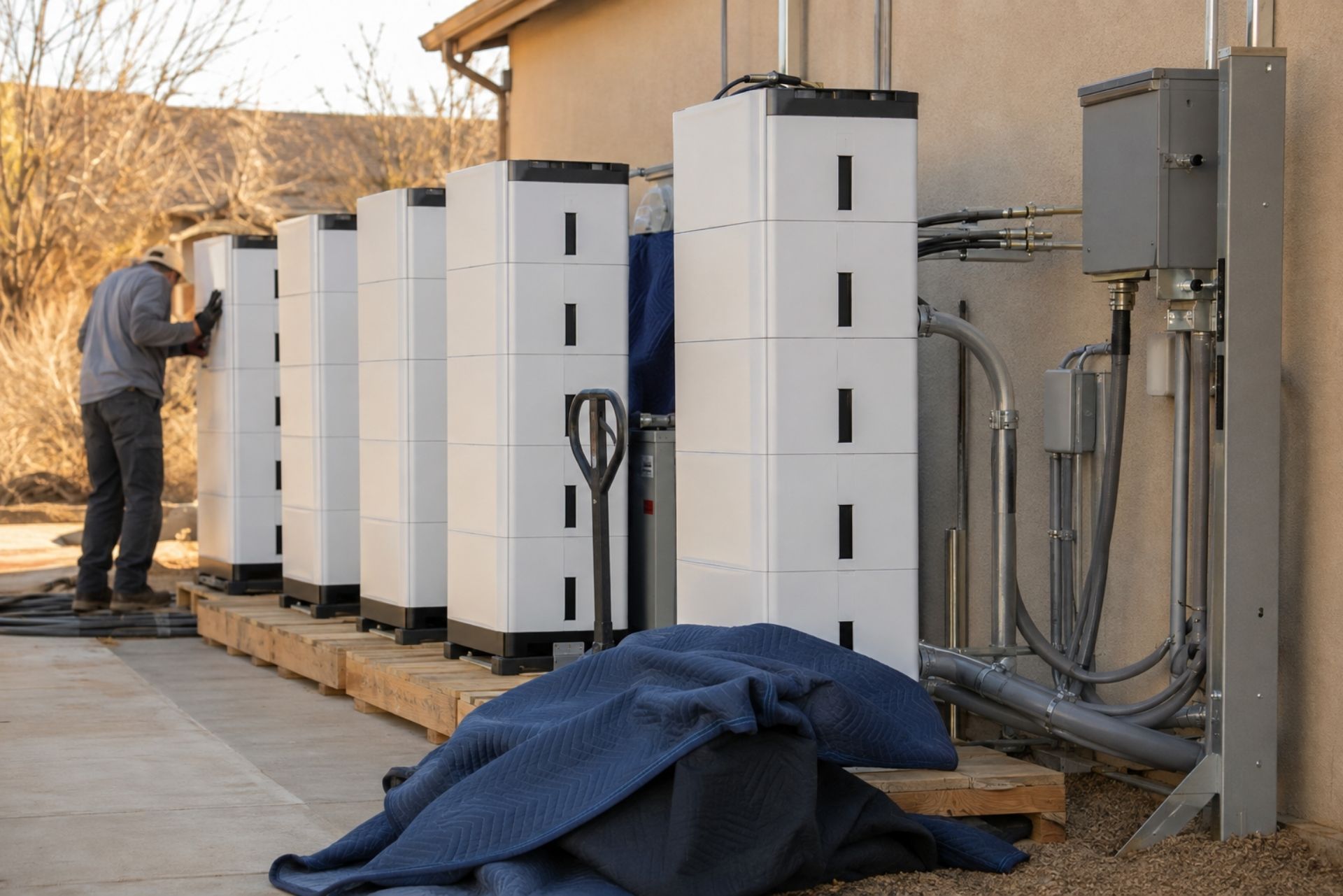
small contracting business. As the home backup battery market surges through 2026, electrical contractors adding energy storage system (ESS) installations to their service mix face a risk profile that standard insurance policies were never designed to handle. Battery storage installer insurance that specifically addresses fire, thermal runaway, and environmental contamination isn't a luxury anymore: it's a business survival tool. The gap between what a typical
general liability policy covers and what an ESS-related claim actually looks like is wider than most contractors realize, and that gap is where businesses get destroyed. Premiums for battery storage projects
currently range from 0.3% to 1.2% of total project value, but the cost of being underinsured dwarfs those numbers by orders of magnitude. If you're a
licensed electrical contractor installing lithium-ion batteries in homes or
commercial spaces, understanding exactly what your policy does and doesn't cover could be the most important business decision you make this year.
Understanding the Unique Risks of Battery Storage Installations
Battery installations carry risks that are fundamentally different from traditional electrical work. A miswired panel might trip a breaker. A poorly installed battery system can cause a cascading thermal event that burns down a house and releases hydrogen fluoride gas into the neighborhood. The failure modes are more severe, harder to predict, and often emerge months or years after installation.
Insurance underwriters are paying close attention to this distinction. The claims data from ESS incidents shows patterns that don't match typical electrical contractor losses: higher severity per claim, longer tails on
liability exposure, and environmental cleanup costs that can exceed the property damage itself. For contractors, this means your existing coverage almost certainly has
gaps that need filling.
The Mechanics of Thermal Runaway in ESS
Thermal runaway happens when a battery cell enters a self-heating cycle that it can't recover from. One cell overheats, which heats adjacent cells, and the chain reaction accelerates until the entire battery pack reaches temperatures exceeding 1,000°F. The process can take minutes or hours, and once it starts, it's extremely difficult to stop.
What triggers it? Manufacturing defects, overcharging, physical damage during installation, or even exposure to ambient heat in poorly ventilated spaces like garages and utility closets. The concerning part for installers is that
fire risk from battery systems remains a persistent concern even as technology improves, and an installation error that seems minor today can manifest as a thermal event two years from now. That's a liability timeline most contractors aren't used to thinking about.
Fire Hazards and Toxic Off-Gassing Risks
The fire itself is only part of the problem. When lithium-ion cells burn, they release a cocktail of toxic gases: hydrogen fluoride, carbon monoxide, phosphorus pentafluoride, and other compounds that can cause severe respiratory damage and require hazmat-level cleanup. A residential battery fire doesn't just damage the home; it can contaminate the surrounding area.
This toxic off-gassing is what transforms a straightforward property damage claim into an environmental liability nightmare. Neighbors may file health-related claims. Local authorities may require soil and air testing. The cleanup costs alone can run into six figures, and most standard liability policies explicitly exclude pollution-related damages.

By: Michael Fusco
President of Joule Pro
INDEX
Joule Pro is a specialty insurance and risk program of Fusco Orsini & Associates Insurance Services, built exclusively for electrical contractors and licensed in 31 states.
We work with electrical firms across the country — from California, Texas, Florida, New York, and coast to coast — placing General Liability, Workers' Compensation, Commercial Auto, Inland Marine, Surety Bonds, Excess Liability, and full specialty coverage stacks for commercial, industrial, service, residential, and low-voltage electrical contractors. Joule Pro is not a separate licensed entity. It is a dedicated program structure inside Fusco Orsini, giving electrical contractors access to specialty carriers, in-house claims advocacy, and trade-specific risk engineering under one program.
Essential Insurance Coverages for Battery Installers
Getting the right coverage means understanding how different policy types interact and where the gaps hide. A single policy won't cover everything, and the specific endorsements you need depend on the types of batteries you install, where you install them, and the scale of your projects.
General Liability vs. Professional Liability (Errors & Omissions)
General liability covers bodily injury and property damage caused by your work. If a battery you installed catches fire and damages a customer's home, GL should respond. But here's where it gets tricky: if the fire resulted from a design recommendation you made (like suggesting a specific battery placement that turned out to be too close to a heat source), that's a professional services error, and GL won't cover it.
Professional liability, or errors and omissions (E&O) insurance, fills that gap. It covers claims arising from your professional advice, design decisions, and system specifications. For ESS installers who help customers choose battery brands, determine system sizing, or recommend installation locations, E&O coverage isn't optional. Joule Pro builds coverage stacks specifically for licensed electrical contractors, including the E&O endorsements that ESS work demands, because a generalist agency often won't even know to ask about these exposures.
Pollution and Environmental Liability for Battery Leaks
Standard GL policies contain pollution exclusions. Read that again, because it matters enormously for battery installers. If a lithium-ion battery leaks electrolyte solution or off-gasses toxic compounds, your general liability policy will likely deny the claim under its pollution exclusion clause.
You need a separate pollution liability endorsement or a standalone environmental liability policy. This coverage pays for cleanup costs, third-party bodily injury from toxic exposure, and regulatory compliance expenses. Given that insurers are increasingly scrutinizing the environmental risks of battery storage systems, getting this coverage before you need it is critical.
Completed Operations Coverage for Long-Term Fire Risks
Here's a scenario that keeps smart contractors up at night: you install a battery system in 2026, your policy renews in 2027 with a different carrier, and the battery catches fire in 2028. Who pays?
Completed operations coverage extends your liability protection to work you've already finished. Without it, you're exposed to claims from every installation in your history. For battery work specifically, this coverage needs to extend for years, because thermal runaway events can occur long after installation due to gradual cell degradation, firmware issues, or environmental factors. Make sure your policy's completed operations tail matches the realistic risk window for the battery systems you install.

Comparing Policy Types: Basic vs. Comprehensive Protection
Not all insurance programs treat ESS risk the same way. The difference between a standard general liability policy and a specialized program designed for battery installers can mean the difference between full coverage and a denied claim.
Comparison Chart: Standard GL vs. Specialized ESS Policies
| Coverage Feature | Standard GL Policy | Specialized ESS Policy |
|---|---|---|
| Bodily injury from fire | Covered | Covered |
| Property damage from thermal runaway | May be covered | Covered with specific ESS endorsement |
| Toxic off-gassing claims | Excluded (pollution exclusion) | Covered via pollution liability add-on |
| Professional design errors | Not covered | Covered with E&O endorsement |
| Completed operations (5+ years) | Often limited to 1-2 years | Extended tail available |
| Recall-related liability | Not covered | May include product recall expense |
| Battery-specific risk assessment | None | Underwriter review of install protocols |
The specialized policy costs more upfront, but the coverage gaps in a standard GL policy are exactly where the most expensive ESS claims land. A program like Joule Pro, which focuses exclusively on electrical contractors, can match you with specialty markets and underwriters who actually understand these exposures rather than forcing your battery work into a generic policy framework.
How to Lower Your Premiums Through Risk Mitigation
Insurance carriers reward contractors who demonstrate lower risk profiles. The good news is that the steps that reduce your premiums also reduce the chance you'll ever need to file a claim.
Manufacturer Training and Certification Requirements
Completing manufacturer-specific training for every battery brand you install is the single most effective way to lower your premiums. Carriers want to see that your technicians understand the specific installation requirements, ventilation needs, and safety protocols for each product line.
Beyond manufacturer training, certifications like NABCEP's Energy Storage Installer credential signal to underwriters that your team follows industry best practices. Some carriers offer premium discounts of 10-15% for certified installers. The knowledge gap between what installers know and what underwriters expect is real, and closing it benefits everyone.
Adhering to NFPA 855 and Local Fire Codes
NFPA 855 is the national standard for ESS installation, covering everything from spacing requirements to ventilation, fire suppression, and signage. Following it isn't just good practice: many jurisdictions now require it, and insurance carriers increasingly use NFPA 855 compliance as an underwriting criterion.
Document everything. Photograph your installations showing clearances, ventilation paths, and disconnect locations. Keep records of your fire code compliance for every job. When a claim arises three years from now, that documentation is what stands between you and a coverage dispute. Carriers that specialize in electrical contractor risk, including the underwriter relationships Joule Pro maintains, often provide compliance checklists that double as underwriting documentation.
Frequently Asked Questions About Battery Insurance
Does standard general liability cover thermal runaway fires?
It depends on the specific policy language, but most standard GL policies will cover fire-related property damage. The problem is everything that comes with a thermal runaway event beyond the fire itself: toxic gas exposure, environmental contamination, and professional liability claims. Those are typically excluded or limited under standard GL.
Why is pollution liability necessary for lithium-ion batteries?
Lithium-ion batteries contain toxic electrolytes and produce hazardous gases when they fail. Standard GL policies exclude pollution-related claims. Without a separate pollution liability endorsement, you're uninsured for environmental cleanup costs and toxic exposure lawsuits, which are often the most expensive part of a battery incident.
How much does ESS installer insurance typically cost?
Premiums vary based on your annual revenue, installation volume, and the types of systems you work with. As a rough benchmark, insurance for battery storage projects runs between 0.3% and 1.2% of total project value. A contractor doing $1 million in annual ESS revenue might pay $3,000 to $12,000 for specialized coverage, though market conditions continue to shift as insurers develop more refined pricing models.
Do I need special coverage if I install batteries in garages?
Yes. Garage installations carry elevated risk because of proximity to vehicles (fuel sources), limited ventilation, and higher ambient temperatures. Some carriers require specific endorsements or impose additional conditions for garage-mounted battery systems. Always disclose installation locations to your insurer.
Will insurance cover me if a battery brand is recalled?
Standard policies typically won't cover recall-related expenses. If a manufacturer recalls a battery you've installed, you may be responsible for removal and replacement labor costs. Some specialized ESS policies include product recall expense coverage, which reimburses you for the labor involved in removing and replacing recalled units. Check your policy language carefully.
Making the Right Choice for Your Business
Battery storage installation is one of the fastest-growing segments for electrical contractors, but the insurance side of the business hasn't kept pace with the risk. Too many contractors are installing ESS systems under policies that will fail them when a thermal runaway event, toxic exposure claim, or environmental cleanup demand hits their desk.
The right coverage stack for ESS work includes general liability with a completed operations tail, professional liability for design and recommendation errors, pollution liability for toxic off-gassing and electrolyte leaks, and enough limits to handle the catastrophic potential of battery fires. That's not a standard package you can buy off the shelf from a generalist agency.
If you're adding battery storage to your service offerings or already installing ESS systems, get your coverage reviewed by someone who understands the specific risks of electrical trade work. Joule Pro works directly with licensed electrical contractors to build coverage programs that match the actual exposures of modern electrical work, including the ESS-specific risks that continue to shape the renewable energy insurance market in 2026. Talk to a licensed producer who knows your trade before your next installation, not after your first claim.

Founder & CEO
The Force Behind the Program
About the Author:
Michael Fusco.
Fusco Orsini & Associates
Joule Pro exists because Mike Fusco saw electrical contractors getting boilerplate insurance — and built a program designed for the way the trade actually works.
Mike is the CEO and co-founder of Fusco Orsini & Associates, the San Diego–based independent agency he launched in 2010. Under his leadership FOA has grown into a nationwide partner serving clients across 31 states, with a personal, client-first approach to commercial insurance and risk.
With over 20 years in insurance and risk management, he specializes in tailored programs spanning general liability, workers' compensation, surety bonding, and employee benefits — helping owners confidently manage risk and pursue growth.
Mike holds a B.S. in Business from the University of Maryland — Robert H. Smith School of Business, and the Certified Insurance Counselor (CIC) designation, held by fewer than 3% of insurance professionals nationwide.
What Our Clients Say
Trusted by Electrical Contractors Across the Country.
5.0
★★★★★
Google reviews
Core Commercial Coverage
Business Insurance for Electrical Contractors.
The fundamentals — written, structured, and priced for electrical risk. Each line is reviewed annually by an underwriter who only writes our trade.
01
General Liability
Premises & completed-operations coverage with electrical-specific endorsements and full pollution carve-back options.
02
Workers' Compensation
Class-code optimization, experience-mod review, and return-to-work programs designed for energized-work exposures.
03
Commercial Auto
Fleet, hired & non-owned auto, and tools-in-transit coverage written for service vans and bucket trucks.
04
Tools & Equipment
Scheduled and blanket coverage for tools, test equipment, scissor lifts, and contractor's equipment on-site or in-transit.
05
Surety Bonds
Bid, performance, and payment bonds — single-job and aggregate programs for commercial & public-works contracts.
06
Commercial Property
Layered limits up to $50M with carrier panels covering your shop, warehouse, yard, and on-premises tools, materials, and equipment.
Who We Serve
Electrical Contractors We Specialize In.
From $5M service shops to $250M industrial primes — every Joule Pro program is shaped to the contractor's revenue mix and project profile.
01 / Industrial
Commercial & Industrial Electrical Contractors
High-voltage, substation, and plant electrical work. Pollution, builder's risk, and large-deductible WC programs.
02 / Service
Service & Residential Electrical Contractors
Service-call shops, panel upgrades, and EV charging installers. Auto-fleet, GL, and tool-coverage programs.
03 / Low-Voltage
Specialty & Low-Voltage Contractors
Data, fire-alarm, security, and BMS controls. Cyber, professional liability, and follow-form excess.
Frequently Asked Questions
Common
Questions From
Electrical Contractors.
What size electrical contractors do you write?
Joule Pro is built for licensed electrical firms from roughly $2M in revenue to $250M+. Below $2M we typically refer to our small-business desk; above $250M we underwrite individually with our industrial practice team.
Do I need to be licensed in multiple states?
No. We license you wherever you work. Joule Pro is admitted in 31 states and our compliance team handles multi-state filings, prevailing-wage endorsements, and certificate-of-insurance requirements.
How is Joule Pro different from a generic contractor program?
Generic programs use a contractor's questionnaire that treats you like a roofer. We use forms written for energized work, arc-flash exposures, and design-build risk — and our carriers price accordingly.
What does the claims process actually look like?
Every Joule Pro client is assigned a named claims advocate at bind. They take the FNOL, set strategy with your assigned attorney, and serve as your single point of contact through close.
Can you bond large public-works contracts?
Yes. Through our surety partners we write single-job bonds up to $75M and aggregate programs to $300M, with expedited turnarounds for school district, federal, and DOT work.
What happens at renewal?
Your producer and claims advocate jointly run a renewal review 90 days out — covering loss trends, exposure changes, and market alternatives — so renewal day is a confirmation, not a surprise.
From the Blog
Insights for Electrical Contractors.
Risk briefings, claim post-mortems, and program updates — written by our underwriters and risk engineers.


Get Started
Get a Quote on a Program Built Around Your Trade.
A 30-minute discovery call is the only commitment. You'll leave with a written gap analysis of your current program — yours to keep, whether you bind with us or not.