
Business Insurance
Home Battery and Energy Storage Installer Insurance
★★★★★ 150+ Five-Star Reviews · Google & Facebook
A single residential battery installation gone wrong can generate six- or seven-figure claims faster than almost any other electrical trade job. A lithium-ion cell enters thermal runaway, a garage fire erupts three months after your crew leaves, and suddenly you're facing property damage, bodily injury allegations, and a homeowner's attorney demanding answers. The insurance you carry for standard panel upgrades and service work probably wasn't designed for these scenarios.
Insurance coverage for home battery and
energy storage installers needs to address a specific cluster of risks: fire and thermal runaway exposure, completed operations liability that extends long after you pull your trucks off the driveway, products liability for hardware you didn't manufacture but did install, protection for expensive tools and diagnostic equipment, and commercial auto policies that account for hauling hazardous materials. The BESS insurance market was
valued at $4.8 billion in 2025 and is projected to reach $14 billion within the decade, a clear signal that underwriters see this segment as both high-growth and high-risk. Getting the right coverage stack, with appropriate limits and deductibles, is the difference between surviving a major claim and shutting your doors. This guide breaks down each piece of that stack so you can make informed decisions about what your business actually needs.
Understanding Liability Risks in Energy Storage Systems
Battery storage work introduces hazards that most
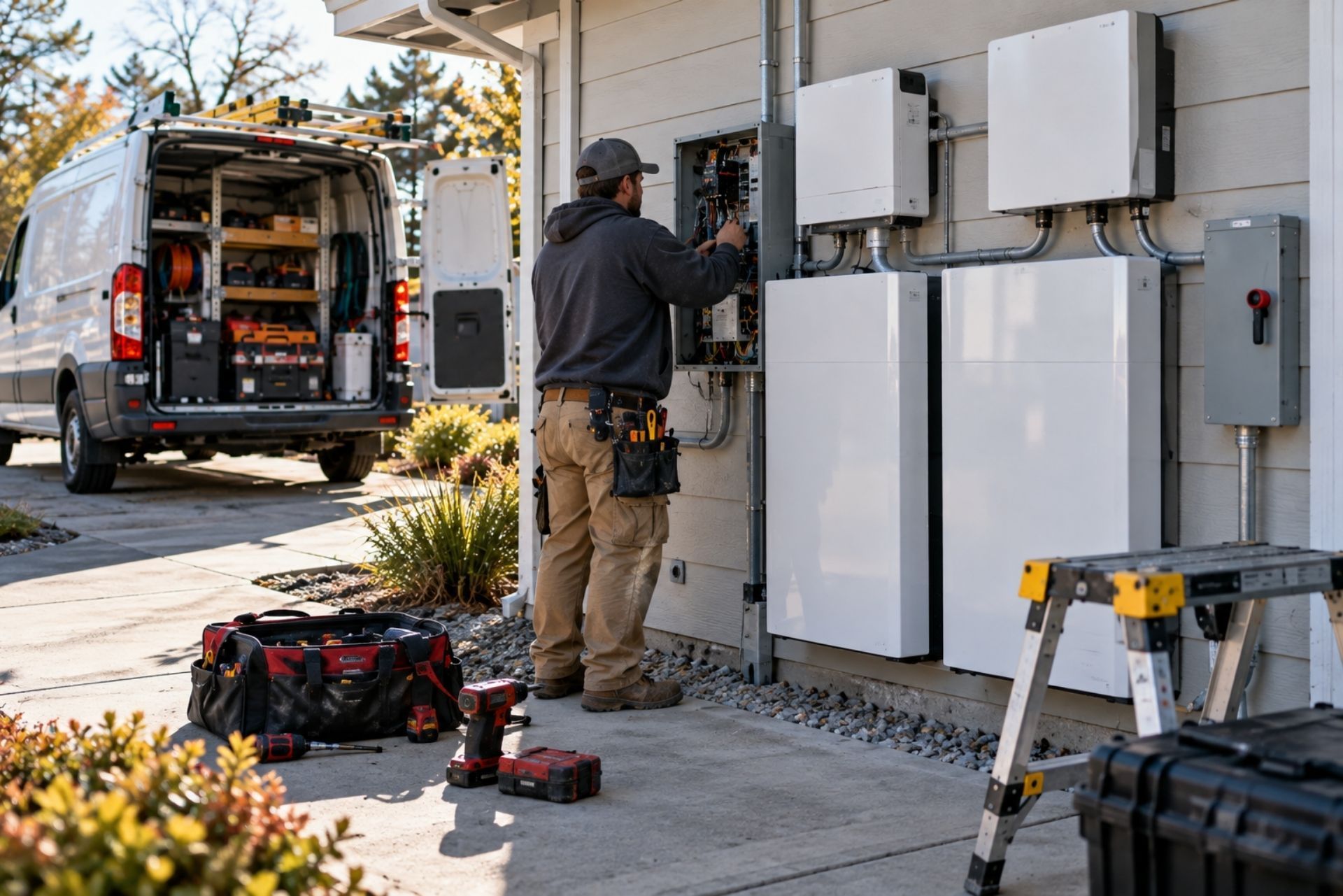
general liability policies weren't built to handle. Unlike a traditional electrical panel swap, installing a 13-kWh lithium-ion battery system in a
residential garage means placing a potential ignition source inside someone's home, one that remains energized 24/7 for years after your crew finishes. The
liability profile is closer to installing a gas appliance than wiring a subpanel. Your insurance program needs to reflect that reality, and many off-the-shelf contractor policies don't.
Managing Fire and Thermal Runaway Hazards
Thermal runaway is the nightmare scenario. A single cell overheats, triggers adjacent cells, and within minutes you have an uncontrollable exothermic reaction that produces toxic gases and temperatures exceeding 1,000°F. Lithium-ion batteries are a growing source of costly fire claims across residential and commercial properties, and insurers are paying close attention.
Your general liability policy may cover fire damage you cause during installation, but the language around battery-specific perils varies wildly between carriers. Some policies contain exclusions for "stored energy" or "chemical reaction" losses that could gut your coverage exactly when you need it. Look for endorsements that explicitly name thermal runaway, off-gassing, and lithium-ion fire as covered perils. If your insurer can't tell you whether those events are covered, that's your answer: they probably aren't.
Completed Operations: Protection After the Install
Here's the part that catches contractors off guard. Most battery failures don't happen while your crew is on-site. They happen weeks, months, or years later, often triggered by a firmware glitch, a manufacturing defect, or environmental conditions you couldn't have predicted. Completed operations coverage is what protects you after you've finished the job and moved on.
A standard CGL policy includes completed operations, but the
aggregate limit is shared with your general liability. If you're doing 200 battery installs a year and one goes sideways eighteen months later, you need enough completed operations capacity to handle a serious claim without exhausting your aggregate. Some contractors carry a separate completed operations tail or negotiate project-specific limits for larger residential installs. This is one area where working with a specialty program like Joule Pro matters, because a generalist agent may not even flag the exposure.
Products Liability for Battery Hardware Failures
You didn't manufacture the battery. You didn't design the inverter. But if a homeowner's Tesla Powerwall or Enphase IQ catches fire, you can bet your company will be named in the lawsuit alongside the manufacturer. Products liability coverage protects you when installed hardware fails and causes damage or injury.
The key distinction: your CGL products liability coverage typically applies to products you sell or distribute, not just install. If you're sourcing batteries from a distributor and reselling them as part of your installation package, you're in the distribution chain. That means products liability exposure is real, even if you had nothing to do with the defect. Make sure your policy doesn't exclude "products you install but don't manufacture," a common gap in contractor-grade policies.

By: Michael Fusco
President of Joule Pro
INDEX
Understanding Liability Risks in Energy Storage Systems
Essential Property and Asset Coverage for Installers
Coverage Comparison: General Liability vs. Specialized Storage Policies
How Homeowner Insurance Intersects with Installer Liability
Determining Appropriate Policy Limits and Deductibles
Common Questions About Battery Installation Insurance
State-Specific Licensing and Insurance Requirements
Risk Management Practices That Lower Premiums
Joule Pro is a specialty insurance and risk program of Fusco Orsini & Associates Insurance Services, built exclusively for electrical contractors and licensed in 31 states.
We work with electrical firms across the country — from California, Texas, Florida, New York, and coast to coast — placing General Liability, Workers' Compensation, Commercial Auto, Inland Marine, Surety Bonds, Excess Liability, and full specialty coverage stacks for commercial, industrial, service, residential, and low-voltage electrical contractors. Joule Pro is not a separate licensed entity. It is a dedicated program structure inside Fusco Orsini, giving electrical contractors access to specialty carriers, in-house claims advocacy, and trade-specific risk engineering under one program.
Essential Property and Asset Coverage for Installers
Your liability coverage protects you from third-party claims. But what about your own stuff: the $40,000 worth of diagnostic tools, battery-lifting equipment, and specialized PPE your crews carry to every job?
Inland Marine: Protecting Tools and Mobile Equipment
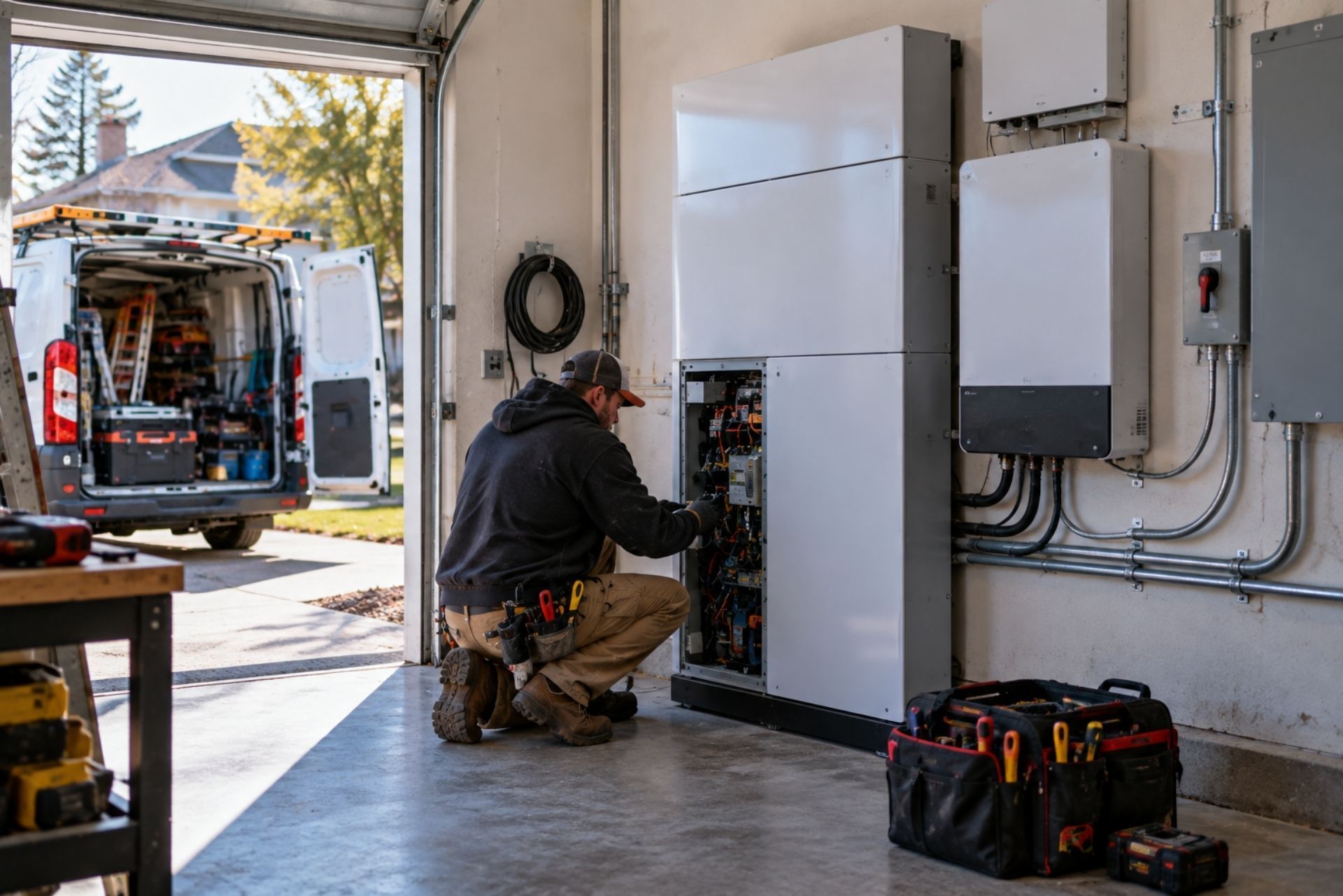
Inland marine insurance covers tools, equipment, and materials in transit or stored at job sites. For battery installers, this includes battery analyzers, torque wrenches calibrated for specific lug connections, insulated hand tools rated for high-voltage DC work, and sometimes the batteries themselves before installation.
A standard property policy only covers items at your listed business location. The moment your crew loads a $3,000 Fluke meter into a van and drives to a job site, it's outside that coverage territory. Inland marine fills the gap. Policies can be written on a scheduled basis (listing specific high-value items) or as a blanket covering all tools up to a stated limit. Most battery installers need at least $50,000 to $75,000 in tool coverage, and crews running multiple vans should consider per-vehicle sublimits.
Commercial Auto for Transporting Hazardous Materials
Your commercial auto policy does more than cover fender benders. When your vans are loaded with lithium-ion battery modules, you're transporting hazardous materials, and your auto policy needs to reflect that. Standard commercial auto often excludes or limits coverage for cargo classified as dangerous goods under DOT regulations.
Battery modules in transit require specific cargo liability endorsements. If a van is rear-ended and battery cells are punctured, the resulting fire and hazmat response can easily cost $100,000 or more before anyone even files a liability claim. Make sure your commercial auto policy includes pollution liability for transported goods and that your carrier knows exactly what your vehicles carry. Failing to disclose hazardous cargo is one of the fastest ways to get a claim denied.
Coverage Comparison: General Liability vs. Specialized Storage Policies
Not all policies are created equal. Here's how a standard contractor GL policy stacks up against a program designed for energy storage installers:
| Coverage Feature | Standard Contractor GL | Specialized Energy Storage Policy |
|---|---|---|
| Thermal runaway / battery fire | Often excluded or ambiguous | Explicitly covered |
| Completed operations tail | Shared aggregate, limited | Higher sublimits available |
| Products liability for installed hardware | May exclude "install-only" scenarios | Covers full distribution chain |
| Pollution / off-gassing | Typically excluded | Endorsement available |
| Inland marine for battery equipment | Separate policy required | Often bundled |
| Hazmat auto cargo | Rarely included | Endorsement standard |
The price difference between these two approaches is usually 15-30% on premium, but the coverage gap can be enormous. A $2 million claim denied under a standard policy because of a chemical reaction exclusion will cost you far more than the premium difference ever would.
How Homeowner Insurance Intersects with Installer Liability
This is a wrinkle many contractors overlook. When you install a battery system, you're changing the risk profile of the homeowner's property. Home battery systems can affect homeowners' insurance premiums and coverage terms, and some homeowner policies exclude or limit coverage for energy storage systems entirely. If a homeowner's claim is denied because their carrier didn't know about the battery, guess who they're coming after? You.
Smart installers build a disclosure step into their contract process, advising homeowners to notify their insurance carrier before installation. Solar and battery additions can change how a home is underwritten, and a simple heads-up can prevent a coverage dispute that eventually lands on your desk as a liability claim.
Determining Appropriate Policy Limits and Deductibles
Choosing limits isn't guesswork. It's a calculation based on your contract requirements, the value of properties you work on, and the worst-case scenario you can realistically imagine.
Balancing Aggregate Limits with Contract Requirements
Most general contractors and homebuilders require their subs to carry at least $1 million per occurrence and $2 million aggregate in general liability. For battery installers, that baseline is often insufficient. A single residential fire claim involving a battery system can easily exceed $1 million when you factor in property damage, temporary housing, personal property loss, and legal defense costs.
If you're doing volume work (50+ installs per year), consider whether a $2 million aggregate gives you enough runway. Two moderate claims in the same policy year could exhaust your aggregate and leave you uninsured for the rest of the term. Many battery installers are moving to $3 million or $4 million aggregates, especially those working in high-value residential markets.
The Role of Umbrella and Excess Liability Layers
An umbrella policy sits on top of your GL, auto, and employer's liability, providing additional limits when underlying policies are exhausted. For battery installers, a $2 million to $5 million umbrella is increasingly standard.
The cost is surprisingly reasonable: a $2 million umbrella for a small installation company might run $1,500 to $3,000 annually. Compare that to the cost of a single catastrophic fire claim, and the math is obvious. Umbrella policies also tend to broaden coverage slightly, picking up some claims that fall outside the strict terms of underlying policies. Joule Pro can help you structure these layers so they actually respond when you need them, rather than leaving gaps between your primary and excess coverage.
Common Questions About Battery Installation Insurance
Do I need separate insurance for battery work if I already have an electrical contractor policy? You might, depending on your current policy language. Many standard electrical contractor policies contain exclusions for stored energy systems or chemical reactions. Have your agent review the exclusions page specifically for battery-related perils.
What happens if a battery I installed catches fire two years after the job? Your completed operations coverage should respond, assuming the policy was in force when the installation occurred and the claim is made during the policy period or extended reporting period. This is why maintaining continuous coverage matters.
Does my commercial auto policy cover battery transport automatically? Usually not. Lithium-ion batteries are classified as hazardous materials for transport purposes, and most standard commercial auto policies exclude or limit hazmat cargo coverage. You'll need a specific endorsement.
How much does specialized battery installer insurance cost? Premiums vary based on revenue, number of installs, geographic location, and claims history. A small operation doing 50-100 residential installs per year might pay $8,000 to $15,000 annually for a full coverage stack including GL, completed operations, inland marine, and commercial auto.
Should I require the battery manufacturer to add me as an additional insured? Yes, whenever possible. Being listed as an additional insured on the manufacturer's products liability policy gives you a secondary layer of protection if their product fails.
State-Specific Licensing and Insurance Requirements
Battery installation licensing requirements vary significantly by state. California, for instance, requires a C-10 electrical license for most battery storage work and mandates specific insurance minimums. Florida has different contractor classification rules that can affect which insurance lines you're required to carry. Some states are beginning to require separate energy storage contractor licenses with their own bonding and insurance thresholds. Check your state contractor licensing board for current requirements, and make sure your insurance program meets or exceeds those minimums.
Risk Management Practices That Lower Premiums
Underwriters reward contractors who take risk seriously. Implementing a documented quality assurance checklist for every battery install, maintaining manufacturer certification for the brands you install, and conducting post-installation inspections at 30 and 90 days can all reduce your premium at renewal. Some carriers offer 5-10% credits for contractors who complete annual battery safety training. Keeping a clean claims history for three or more years is the single most effective way to lower your rates over time.
Why Specialty Programs Outperform Generalist Brokers
A generalist insurance broker handles everything from restaurants to roofing companies. They're unlikely to understand the difference between AC-coupled and DC-coupled battery systems, why thermal runaway is distinct from a standard electrical fire, or how completed operations exposure compounds with installation volume. Joule Pro was built specifically for licensed electrical contractors, with underwriter relationships and policy forms designed for the risks your crews face daily. That specialization means fewer coverage gaps, faster claims handling, and premiums that reflect your actual risk profile rather than a generic contractor class code.
Making the Right Choice for Your Business
The battery storage market is growing fast, and so are the claims. Every installation you complete creates a long-tail liability exposure that persists for years. The right insurance program doesn't just check a box for your general contractor or homeowner client: it protects your company's ability to keep operating after a serious incident.
Start by auditing your current policy for battery-specific exclusions. Review your completed operations and products liability limits against your actual installation volume. Make sure your commercial auto and inland marine coverage reflect what your crews actually carry and transport. And work with a program that understands electrical trade risks at a granular level, not a generalist who treats your battery work the same as a panel upgrade. If you want a coverage review from someone who speaks your language, reach out to Joule Pro for a consultation tailored to your specific operation and risk profile.

Founder & CEO
The Force Behind the Program
About the Author:
Michael Fusco.
Fusco Orsini & Associates
Joule Pro exists because Mike Fusco saw electrical contractors getting boilerplate insurance — and built a program designed for the way the trade actually works.
Mike is the CEO and co-founder of Fusco Orsini & Associates, the San Diego–based independent agency he launched in 2010. Under his leadership FOA has grown into a nationwide partner serving clients across 31 states, with a personal, client-first approach to commercial insurance and risk.
With over 20 years in insurance and risk management, he specializes in tailored programs spanning general liability, workers' compensation, surety bonding, and employee benefits — helping owners confidently manage risk and pursue growth.
Mike holds a B.S. in Business from the University of Maryland — Robert H. Smith School of Business, and the Certified Insurance Counselor (CIC) designation, held by fewer than 3% of insurance professionals nationwide.
What Our Clients Say
Trusted by Electrical Contractors Across the Country.
5.0
★★★★★
Google reviews
Core Commercial Coverage
Business Insurance for Electrical Contractors.
The fundamentals — written, structured, and priced for electrical risk. Each line is reviewed annually by an underwriter who only writes our trade.
01
General Liability
Premises & completed-operations coverage with electrical-specific endorsements and full pollution carve-back options.
02
Workers' Compensation
Class-code optimization, experience-mod review, and return-to-work programs designed for energized-work exposures.
03
Commercial Auto
Fleet, hired & non-owned auto, and tools-in-transit coverage written for service vans and bucket trucks.
04
Tools & Equipment
Scheduled and blanket coverage for tools, test equipment, scissor lifts, and contractor's equipment on-site or in-transit.
05
Surety Bonds
Bid, performance, and payment bonds — single-job and aggregate programs for commercial & public-works contracts.
06
Commercial Property
Layered limits up to $50M with carrier panels covering your shop, warehouse, yard, and on-premises tools, materials, and equipment.
Who We Serve
Electrical Contractors We Specialize In.
From $5M service shops to $250M industrial primes — every Joule Pro program is shaped to the contractor's revenue mix and project profile.
01 / Industrial
Commercial & Industrial Electrical Contractors
High-voltage, substation, and plant electrical work. Pollution, builder's risk, and large-deductible WC programs.
02 / Service
Service & Residential Electrical Contractors
Service-call shops, panel upgrades, and EV charging installers. Auto-fleet, GL, and tool-coverage programs.
03 / Low-Voltage
Specialty & Low-Voltage Contractors
Data, fire-alarm, security, and BMS controls. Cyber, professional liability, and follow-form excess.
Frequently Asked Questions
Common
Questions From
Electrical Contractors.
What size electrical contractors do you write?
Joule Pro is built for licensed electrical firms from roughly $2M in revenue to $250M+. Below $2M we typically refer to our small-business desk; above $250M we underwrite individually with our industrial practice team.
Do I need to be licensed in multiple states?
No. We license you wherever you work. Joule Pro is admitted in 31 states and our compliance team handles multi-state filings, prevailing-wage endorsements, and certificate-of-insurance requirements.
How is Joule Pro different from a generic contractor program?
Generic programs use a contractor's questionnaire that treats you like a roofer. We use forms written for energized work, arc-flash exposures, and design-build risk — and our carriers price accordingly.
What does the claims process actually look like?
Every Joule Pro client is assigned a named claims advocate at bind. They take the FNOL, set strategy with your assigned attorney, and serve as your single point of contact through close.
Can you bond large public-works contracts?
Yes. Through our surety partners we write single-job bonds up to $75M and aggregate programs to $300M, with expedited turnarounds for school district, federal, and DOT work.
What happens at renewal?
Your producer and claims advocate jointly run a renewal review 90 days out — covering loss trends, exposure changes, and market alternatives — so renewal day is a confirmation, not a surprise.
From the Blog
Insights for Electrical Contractors.
Risk briefings, claim post-mortems, and program updates — written by our underwriters and risk engineers.


Get Started
Get a Quote on a Program Built Around Your Trade.
A 30-minute discovery call is the only commitment. You'll leave with a written gap analysis of your current program — yours to keep, whether you bind with us or not.