Business Insurance
Home Electrification Contractor Insurance
★★★★★ 150+ Five-Star Reviews · Google & Facebook
A single miswired heat pump or a battery storage system that overheats six months after installation can generate claims that dwarf the original contract value. For
electrical contractors working in
home electrification, the risk profile is distinct from traditional electrical work, and your insurance needs to reflect that. The right coverage stack for home electrification contractor insurance spans
general liability, completed operations,
tools and equipment,
commercial auto, workers' comp, and
certificates of insurance. Each piece serves a specific function, and gaps between them are where contractors get burned. With the electrification market still expanding thanks to federal incentive programs and growing demand driven by the Inflation Reduction Act, more electrical contractors are taking on heat pump installs,
EV charger wiring,
panel upgrades, and battery storage projects than ever before. That growth is great for revenue, but it also means more exposure to claims you might not have faced five years ago. Here's what you actually need to know about each coverage type and how they fit together.
Core Liability Coverage for Electrification Projects
Home electrification work creates a specific set of liability exposures that general contractors or traditional electricians don't always face. You're installing systems that interact with a home's entire electrical infrastructure, often touching HVAC, solar, and battery storage in a single project. The liability profile is broader because the systems are interconnected: a panel upgrade gone wrong can affect everything downstream.
The
2026 construction insurance market is seeing tighter underwriting around renewable and electrification projects specifically because claims frequency and severity have both increased. Insurers are paying closer attention to the types of work you perform, not just your license classification. That's why understanding your core liability coverages matters more now than it did even two years ago.
General Liability for Third-Party Risks
General liability (GL) is your first line of defense against claims from people who aren't your employees. If a homeowner trips over your equipment and breaks a wrist, or you accidentally damage their hardwood floors while running conduit, GL responds. It covers bodily injury and property damage claims from third parties, plus your legal defense costs.
For electrification contractors, GL policies need to be written with your specific operations in mind. A policy designed for a general handyman won't adequately cover the risks of installing a 200-amp panel upgrade or wiring a Level 2 EV charger. Pay attention to your policy's per-occurrence and aggregate limits: most residential GCs and homeowners require you to carry at least $1 million per occurrence and $2 million aggregate. Some utility rebate programs won't even list you as an approved installer without proof of adequate GL coverage.
Completed Operations: Protecting Against Post-Install Failures
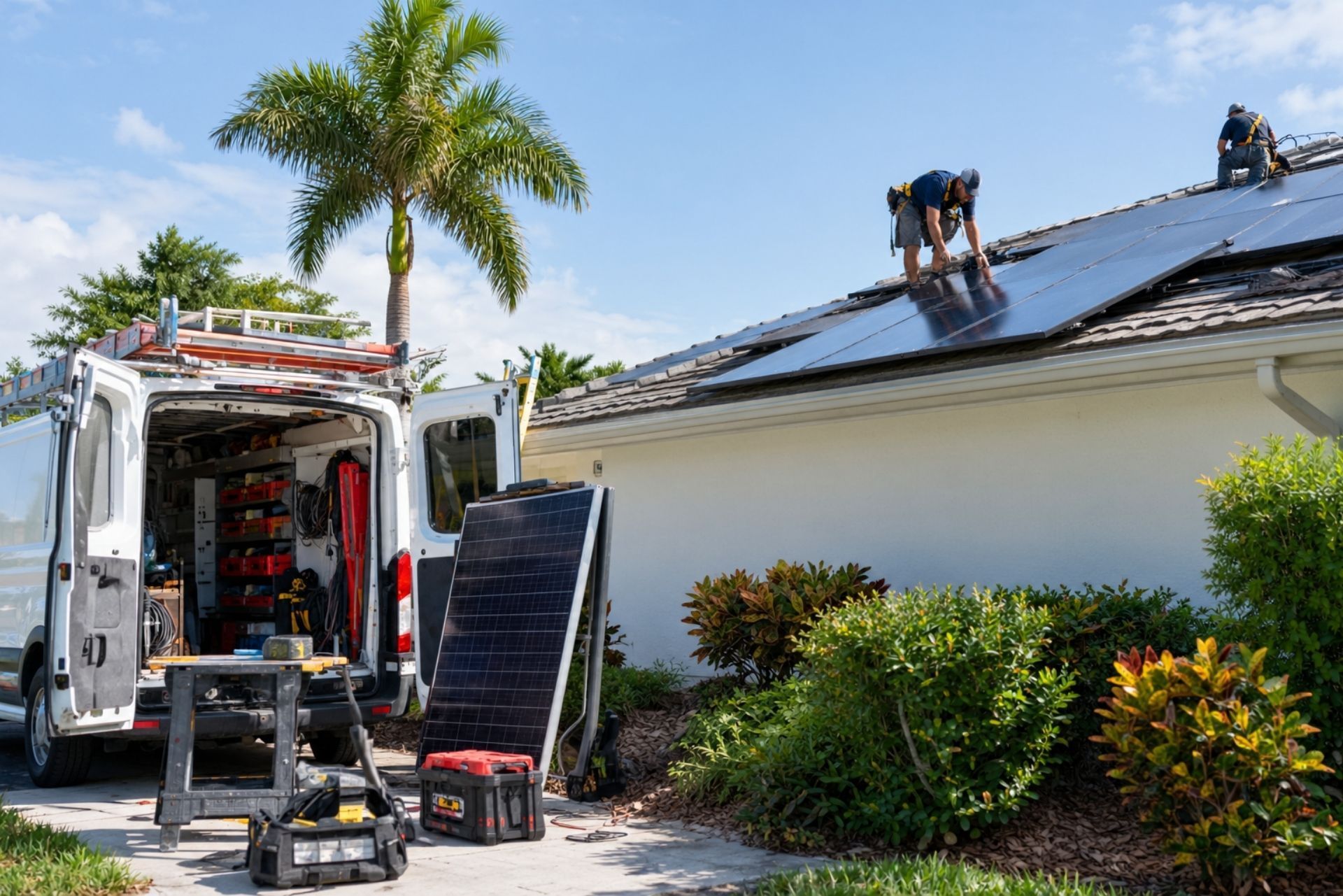
This is the coverage that keeps contractors up at night, or should. Completed operations kicks in after you've finished a job, packed up your tools, and moved on. If that heat pump wiring fails three months later and causes water damage, or a battery storage system overheats and starts a fire, completed operations is what responds.
The data here is sobering:
84% of solar-related fire events are equipment-driven brushfires originating from the installation itself rather than external wildfires. Battery energy storage systems carry their own distinct fire and thermal runaway risks that insurers are scrutinizing closely. If your GL policy excludes or limits completed operations coverage, you're exposed to the most expensive category of claims in electrification work. Make sure completed operations is included and that the limits match your GL limits.

By: Michael Fusco
President of Joule Pro
INDEX
Joule Pro is a specialty insurance and risk program of Fusco Orsini & Associates Insurance Services, built exclusively for electrical contractors and licensed in 31 states.
We work with electrical firms across the country — from California, Texas, Florida, New York, and coast to coast — placing General Liability, Workers' Compensation, Commercial Auto, Inland Marine, Surety Bonds, Excess Liability, and full specialty coverage stacks for commercial, industrial, service, residential, and low-voltage electrical contractors. Joule Pro is not a separate licensed entity. It is a dedicated program structure inside Fusco Orsini, giving electrical contractors access to specialty carriers, in-house claims advocacy, and trade-specific risk engineering under one program.
Comparing Essential Policy Types
Not all coverages serve the same purpose, and understanding the differences helps you avoid buying what you don't need while making sure you're not missing what you do.
| Coverage Type | What It Covers | When It Responds | Typical Limit |
|---|---|---|---|
| General Liability | Third-party bodily injury, property damage | During active operations | $1M/$2M |
| Completed Operations | Post-project failures and resulting damage | After job completion | Included in GL aggregate |
| Tools & Equipment | Owned tools, meters, diagnostic equipment | Theft, damage, loss | $5K-$100K+ |
| Commercial Auto | Vehicles used for business | Accidents, liability, physical damage | $1M combined single limit |
| Workers' Comp | Employee injuries and illness on the job | Work-related incidents | State-mandated |
| Certificates (COI) | Proof of coverage for third parties | When requested by GCs/homeowners | N/A (documentation) |
One thing to keep in mind: these coverages aren't interchangeable. Your commercial auto policy won't cover a tool stolen from your van (that's inland marine territory), and your GL won't pay for an employee's broken arm (that's workers' comp). The 2026 construction insurance outlook shows carriers increasingly requiring full coverage stacks before they'll write any single policy, especially for electrification work.
Protecting Physical Assets: Tools and Commercial Vehicles
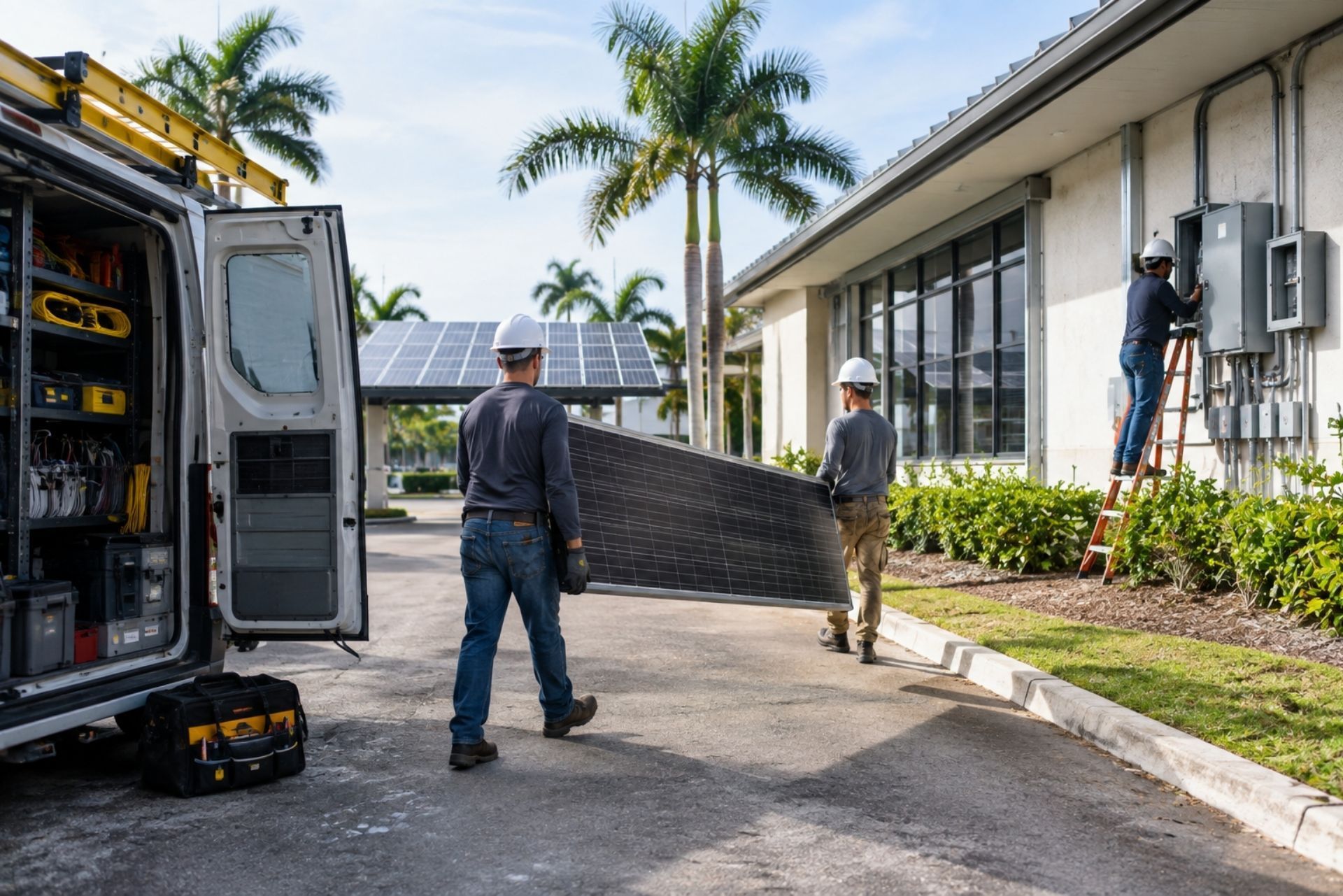
Your tools and vehicles are what make revenue possible. Lose a $15,000 Fluke power quality analyzer or total your service van, and you're not just dealing with replacement costs: you're losing income every day you can't work.
Inland Marine Insurance for High-End Specialized Tools
The name "inland marine" sounds like it belongs on a cargo ship, but it's actually the standard coverage for tools, equipment, and materials in transit or stored at job sites. Your standard business property policy typically only covers items at your listed business location. Inland marine fills the gap for everything that travels with you.
Electrification contractors carry expensive, specialized equipment. Meggers, thermal imaging cameras, power analyzers, and torque wrenches calibrated for specific battery connections can easily total $30,000 to $50,000 or more across a crew. A standard contractor's tools floater might cap at $5,000 or $10,000, which won't come close to replacing what a well-equipped electrification crew carries. Work with a specialty program like Joule Pro that understands the actual tool inventory electrical contractors carry, so your coverage limits reflect reality rather than a generic estimate.
Commercial Auto vs. Personal Auto Policies
This is one of the most common coverage gaps I see. Contractors assume their personal auto policy covers them while driving to job sites. It doesn't: at least not reliably. Most personal auto policies exclude or severely limit coverage for vehicles used in business operations. If you're hauling materials, pulling a trailer, or have your company name on the vehicle, you need commercial auto.
Commercial auto policies cover liability if you cause an accident, physical damage to your vehicle, and can include hired and non-owned auto coverage for employees using their personal vehicles on company business. For electrification contractors running multiple service vans, the premium difference between personal and commercial auto is significant, but so is the coverage gap if you have a serious accident while heading to a panel upgrade.
Managing Workforce and Compliance Requirements
Hiring employees or even using subcontractors changes your insurance obligations substantially. The compliance side of contractor insurance is where many small shops get tripped up, often not realizing they're out of compliance until a claim gets denied or a GC pulls them off a project.
Workers' Compensation for Electrical Teams
Workers' comp is mandatory in nearly every state for contractors with employees. Even in states like Texas where it's technically optional, going without it exposes you to direct lawsuits from injured workers with no cap on damages. Electrical work consistently ranks among the higher-risk trade classifications, which means your workers' comp premiums reflect that risk.
The classification codes matter here. Electrification work might fall under different codes depending on whether you're doing panel upgrades, EV charger installations, or battery storage work. Getting classified correctly affects your premium and, more importantly, whether claims get paid. An insurer that specializes in the electrical trade, like Joule Pro, will make sure your payroll is allocated to the right codes rather than lumping everything under a generic electrician classification that might not fit.
Your experience modification rate (EMR or mod rate) also directly impacts your premium. A mod rate above 1.0 means you're paying more than average for your classification, and it can disqualify you from bidding on certain projects. Investing in safety programs and return-to-work protocols pays for itself through lower mod rates over time.
Understanding Certificates of Insurance (COI)
A certificate of insurance is a one-page document that proves you carry specific coverages with specific limits. It's not a policy itself: it's a snapshot that GCs, homeowners, property managers, and utility programs use to verify you're properly insured before you start work.
COI requests are routine, but the details matter. Most GCs will require you to name them as an additional insured on your GL policy, which means your policy extends certain protections to them for work you perform on their projects. Turnaround time on COI requests can make or break whether you land a job. If your insurance provider takes three days to issue a certificate, you might lose the project to a competitor who can produce one in hours. Working with a producer who handles COIs quickly and understands what GCs in the electrification space actually require saves you real money in missed opportunities.
Common Questions About Contractor Insurance
How much does general liability insurance cost for an electrification contractor? Premiums vary based on your revenue, location, claims history, and specific operations, but most small electrification contractors pay between $2,500 and $6,000 annually for a $1M/$2M GL policy. Higher-risk work like battery storage installations can push premiums higher.
Do I need separate coverage for solar and battery storage work? Often, yes. Many standard electrician GL policies exclude or sublimit coverage for solar and battery energy storage systems. Make sure your policy explicitly includes these operations, especially given the growing focus on infrastructure and renewable energy risks in 2026.
Can I use my personal auto insurance for my work van? You shouldn't. Personal auto policies typically exclude business use, and a claim denial after a serious accident could be financially devastating. Commercial auto is a separate policy designed for vehicles used in trade operations.
What happens if I don't carry workers' comp and an employee gets hurt? You become personally liable for their medical bills, lost wages, and potentially a lawsuit with no damages cap. Most states also impose fines or criminal penalties for operating without required workers' comp coverage.
How quickly can I get a certificate of insurance? With a specialty producer, same-day COI issuance is common. Generalist agencies that don't focus on contractor insurance may take several business days, which can cost you jobs.
Does completed operations coverage cost extra? It's typically included within your GL policy rather than sold as a standalone product. That said, the construction insurance market in 2026 is seeing some carriers tighten completed operations terms for electrification work, so verify your limits and exclusions carefully.
Before You Buy a Policy
Getting the right insurance for your electrification contracting business isn't about buying the cheapest policy you can find. It's about building a coverage stack where each piece works together without gaps. Your GL and completed operations protect against liability claims. Inland marine covers the expensive tools that make your work possible. Commercial auto protects your vehicles. Workers' comp keeps you compliant and protects your crew. And certificates tie it all together by proving to GCs and homeowners that you're properly covered.
The electrification market is growing fast, and insurers are still figuring out how to price these risks accurately. That means working with a specialty program matters more than usual. Joule Pro exists specifically for licensed electrical contractors: our team understands the difference between a 200-amp panel upgrade and a whole-home battery install, and we build coverage around those distinctions. Reach out to get a quote from a licensed producer who actually knows your trade, not a chatbot guessing at your classification code.

Founder & CEO
The Force Behind the Program
About the Author:
Michael Fusco.
Fusco Orsini & Associates
Joule Pro exists because Mike Fusco saw electrical contractors getting boilerplate insurance — and built a program designed for the way the trade actually works.
Mike is the CEO and co-founder of Fusco Orsini & Associates, the San Diego–based independent agency he launched in 2010. Under his leadership FOA has grown into a nationwide partner serving clients across 31 states, with a personal, client-first approach to commercial insurance and risk.
With over 20 years in insurance and risk management, he specializes in tailored programs spanning general liability, workers' compensation, surety bonding, and employee benefits — helping owners confidently manage risk and pursue growth.
Mike holds a B.S. in Business from the University of Maryland — Robert H. Smith School of Business, and the Certified Insurance Counselor (CIC) designation, held by fewer than 3% of insurance professionals nationwide.
What Our Clients Say
Trusted by Electrical Contractors Across the Country.
5.0
★★★★★
Google reviews
Core Commercial Coverage
Business Insurance for Electrical Contractors.
The fundamentals — written, structured, and priced for electrical risk. Each line is reviewed annually by an underwriter who only writes our trade.
01
General Liability
Premises & completed-operations coverage with electrical-specific endorsements and full pollution carve-back options.
02
Workers' Compensation
Class-code optimization, experience-mod review, and return-to-work programs designed for energized-work exposures.
03
Commercial Auto
Fleet, hired & non-owned auto, and tools-in-transit coverage written for service vans and bucket trucks.
04
Tools & Equipment
Scheduled and blanket coverage for tools, test equipment, scissor lifts, and contractor's equipment on-site or in-transit.
05
Surety Bonds
Bid, performance, and payment bonds — single-job and aggregate programs for commercial & public-works contracts.
06
Commercial Property
Layered limits up to $50M with carrier panels covering your shop, warehouse, yard, and on-premises tools, materials, and equipment.
Who We Serve
Electrical Contractors We Specialize In.
From $5M service shops to $250M industrial primes — every Joule Pro program is shaped to the contractor's revenue mix and project profile.
01 / Industrial
Commercial & Industrial Electrical Contractors
High-voltage, substation, and plant electrical work. Pollution, builder's risk, and large-deductible WC programs.
02 / Service
Service & Residential Electrical Contractors
Service-call shops, panel upgrades, and EV charging installers. Auto-fleet, GL, and tool-coverage programs.
03 / Low-Voltage
Specialty & Low-Voltage Contractors
Data, fire-alarm, security, and BMS controls. Cyber, professional liability, and follow-form excess.
Frequently Asked Questions
Common
Questions From
Electrical Contractors.
What size electrical contractors do you write?
Joule Pro is built for licensed electrical firms from roughly $2M in revenue to $250M+. Below $2M we typically refer to our small-business desk; above $250M we underwrite individually with our industrial practice team.
Do I need to be licensed in multiple states?
No. We license you wherever you work. Joule Pro is admitted in 31 states and our compliance team handles multi-state filings, prevailing-wage endorsements, and certificate-of-insurance requirements.
How is Joule Pro different from a generic contractor program?
Generic programs use a contractor's questionnaire that treats you like a roofer. We use forms written for energized work, arc-flash exposures, and design-build risk — and our carriers price accordingly.
What does the claims process actually look like?
Every Joule Pro client is assigned a named claims advocate at bind. They take the FNOL, set strategy with your assigned attorney, and serve as your single point of contact through close.
Can you bond large public-works contracts?
Yes. Through our surety partners we write single-job bonds up to $75M and aggregate programs to $300M, with expedited turnarounds for school district, federal, and DOT work.
What happens at renewal?
Your producer and claims advocate jointly run a renewal review 90 days out — covering loss trends, exposure changes, and market alternatives — so renewal day is a confirmation, not a surprise.
From the Blog
Insights for Electrical Contractors.
Risk briefings, claim post-mortems, and program updates — written by our underwriters and risk engineers.


Get Started
Get a Quote on a Program Built Around Your Trade.
A 30-minute discovery call is the only commitment. You'll leave with a written gap analysis of your current program — yours to keep, whether you bind with us or not.