Business Insurance
Arizona Solar Installer Insurance
★★★★★ 150+ Five-Star Reviews · Google & Facebook
Arizona's solar market is booming, and for good reason. The state averages over 300 days of sunshine per year, residential and commercial rooftop installations are climbing steadily, and utility-scale projects continue to draw investment. But here's the thing most solar contractors don't think about until it's too late: one cracked roof tile, one injured crew member, or one system that underperforms can wipe out months of profit. The right insurance program isn't just a box to check for your license - it's the difference between surviving a bad claim and closing your doors. This guide breaks down the essential coverages Arizona
solar installers need, what the state actually requires, how costs are determined, and where most contractors leave gaps in their protection. Whether you're a two-person crew doing
residential installs in Mesa or running
commercial projects across Maricopa County, understanding your insurance stack is non-negotiable. And because solar work blends electrical, roofing, and engineering risks into a single trade, your coverage needs are more complex than a typical electrical contractor's. Getting this wrong is expensive. Getting it right gives you the confidence to bid bigger jobs and sleep well at night.
Essential Insurance Coverages for Arizona Solar Contractors
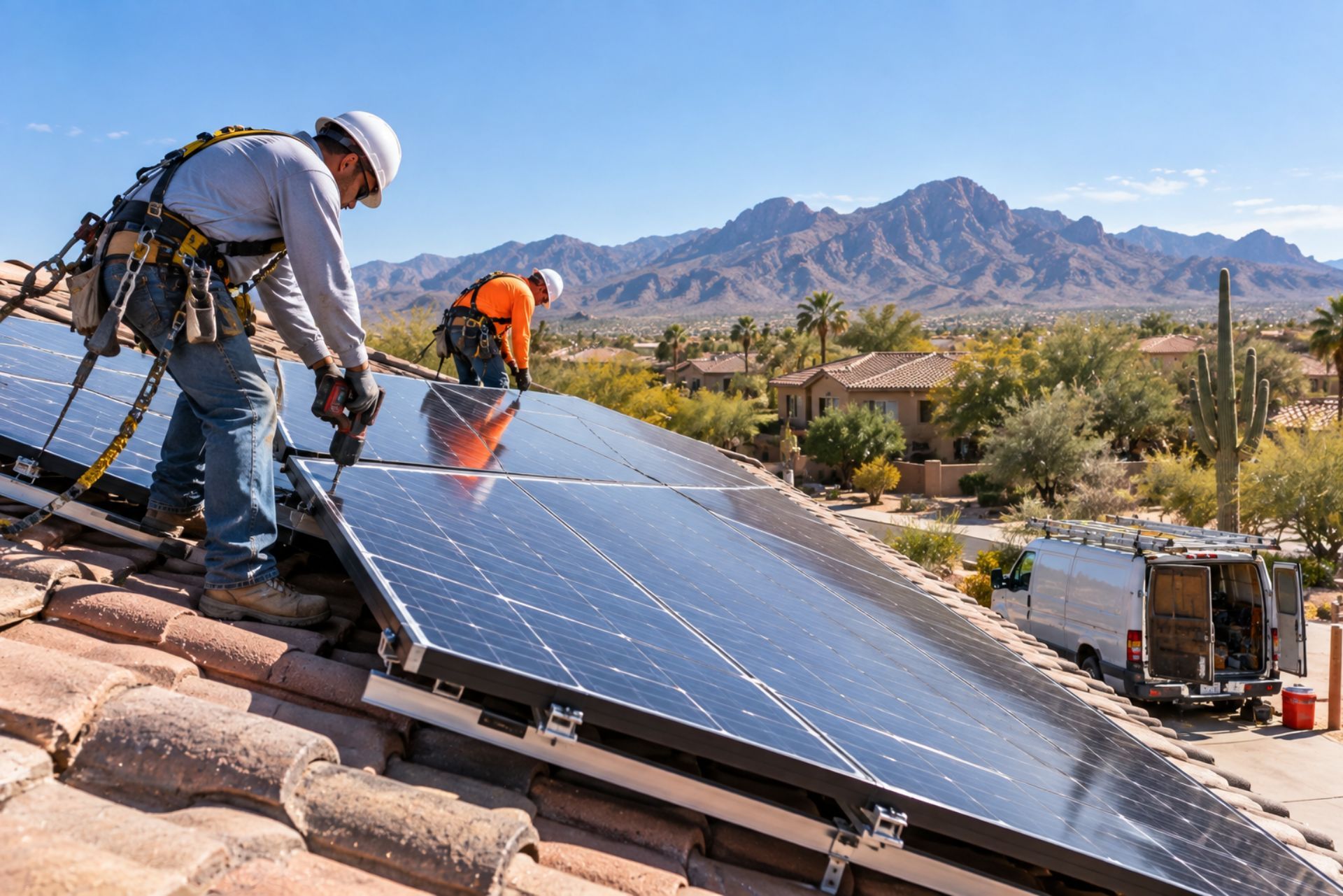
Solar installation sits at the intersection of several high-risk trades. You're working on rooftops, handling expensive equipment, running electrical systems, and often doing it all in 115-degree heat. That combination creates a risk profile that generic contractor policies weren't built to handle.
The core coverages every Arizona solar installer needs include general liability, inland marine (tools and equipment), completed operations, workers' compensation, and professional liability. Each one protects against a different type of loss, and skipping any of them creates a gap that could cost you six figures or more in a single incident.
A specialty program like Joule Pro, built specifically for licensed
electrical contractors, understands these overlapping risks in ways a generalist agency simply doesn't. The underwriting matters because solar-specific endorsements and proper classification codes affect both your coverage quality and your premiums.
General Liability and Completed Operations
General liability is your first line of defense. It covers third-party bodily injury and property damage that happens during your work - think a panel falling off a roof and hitting a homeowner's car, or a crew member accidentally damaging a client's landscaping during installation.
But here's where solar contractors often get caught: general liability typically covers damage that occurs while you're on the job site. What about damage that shows up after you leave? That's where completed operations coverage comes in. If a system you installed six months ago causes a roof leak or an electrical fire, completed operations responds to that claim. Without it, you're personally on the hook.
Most general liability policies for solar contractors carry limits of $1 million per occurrence and $2 million aggregate. Arizona general contractors and property managers regularly require these minimums before they'll let you on a job site. Completed operations is usually included in your general liability policy, but you need to verify it's active and that the limits are adequate for your project sizes. A $500,000 residential roof fire can blow through a thin policy fast.
Inland Marine: Protecting Tools and Solar Equipment in Transit
Solar panels, inverters, racking systems, and specialized electrical tools don't just sit in a warehouse. They're loaded onto trucks, stored at job sites, and moved between locations constantly. Standard commercial property insurance only covers items at your listed business address, which means inland marine coverage fills a critical gap for equipment in transit or temporarily stored at a work site.
A single pallet of solar panels can be worth $15,000 to $30,000. Add in your inverters, conduit benders, multimeters, and power tools, and you're looking at significant exposure every time a truck leaves your shop. Inland marine policies are designed for exactly this scenario - they follow your equipment wherever it goes.
One common mistake: contractors assume their
commercial auto policy covers cargo. It usually doesn't, or the limits are so low they're meaningless. Make sure your inland marine policy lists scheduled high-value items and carries a blanket limit that reflects your actual inventory on any given day.
Professional Liability for System Design and Consultations
If you're designing solar systems, recommending equipment, performing energy production estimates, or advising clients on system sizing, you have professional liability exposure. This coverage protects against claims of negligence, errors, or omissions in your professional services.
Here's a real-world example: you design a 10kW system for a commercial client, projecting specific energy savings. The system underperforms because of a design miscalculation. The client sues for the difference between promised and actual output. General liability won't touch that claim because there's no physical damage - it's a financial loss caused by your professional advice. Professional liability (sometimes called errors and omissions) is the only coverage that responds.
Not every solar installer needs this coverage, but if your business involves any design work, energy audits, or performance guarantees, it's essential.

By: Michael Fusco
President of Joule Pro
INDEX
Joule Pro is a specialty insurance and risk program of Fusco Orsini & Associates Insurance Services, built exclusively for electrical contractors and licensed in 31 states.
We work with electrical firms across the country — from California, Texas, Florida, New York, and coast to coast — placing General Liability, Workers' Compensation, Commercial Auto, Inland Marine, Surety Bonds, Excess Liability, and full specialty coverage stacks for commercial, industrial, service, residential, and low-voltage electrical contractors. Joule Pro is not a separate licensed entity. It is a dedicated program structure inside Fusco Orsini, giving electrical contractors access to specialty carriers, in-house claims advocacy, and trade-specific risk engineering under one program.
Arizona State Requirements and Workers' Compensation
Arizona has specific insurance and licensing requirements for contractors, and solar installers don't get any exceptions. Understanding these mandates keeps you legal, protects your license, and prevents costly penalties.
Understanding AZ Industrial Commission Mandates
Arizona requires workers' compensation insurance for virtually every employer. If you have even one employee, you need a policy. The Arizona Industrial Commission (ICA) enforces this, and penalties for non-compliance include fines, stop-work orders, and even criminal charges for repeat offenders.
The good news for Arizona solar contractors is that workers' comp rates have been trending downward. Arizona approved a 6.7% average reduction in voluntary loss costs for 2026, marking the 12th consecutive year of decreases. That's real savings, especially for trades with historically high rates like rooftop electrical work.
Your workers' comp classification code matters enormously. Solar installers are typically classified under codes that reflect both electrical and roofing work, which carry higher rates than ground-level electrical. Make sure your insurer assigns the correct codes - misclassification can lead to audit surprises or denied claims. Programs like Joule Pro that focus exclusively on electrical contractors understand these classification nuances and can help you avoid overpaying.
One more thing: Arizona's new heat illness prevention guidance, developed in coordination with ICA and ADOSH, directly affects solar crews working on rooftops during summer months. Having a documented heat safety program doesn't just protect your workers - it can positively influence your experience modification rate and, by extension, your premiums.
ROC Licensing and Bond Requirements
Arizona's Registrar of Contractors (ROC) requires solar installers to hold an active contractor's license. Most solar contractors operate under the C-11 (Electrical) or CR-11 (Residential Electrical) classification, though some also carry a KB-2 (Dual) license for combined solar and roofing work.
The ROC requires a surety bond as part of the licensing process, typically $5,000 for residential contractors and $10,000 for commercial or dual-licensed contractors. This bond protects consumers - it's not a substitute for insurance. You still need general liability, workers' comp, and the other coverages we've discussed.
Letting your insurance lapse can trigger an ROC license suspension. The state cross-references insurance certificates with active licenses, so gaps in coverage create gaps in your ability to legally operate.
Comparing Coverage Needs: Residential vs. Commercial Solar Projects
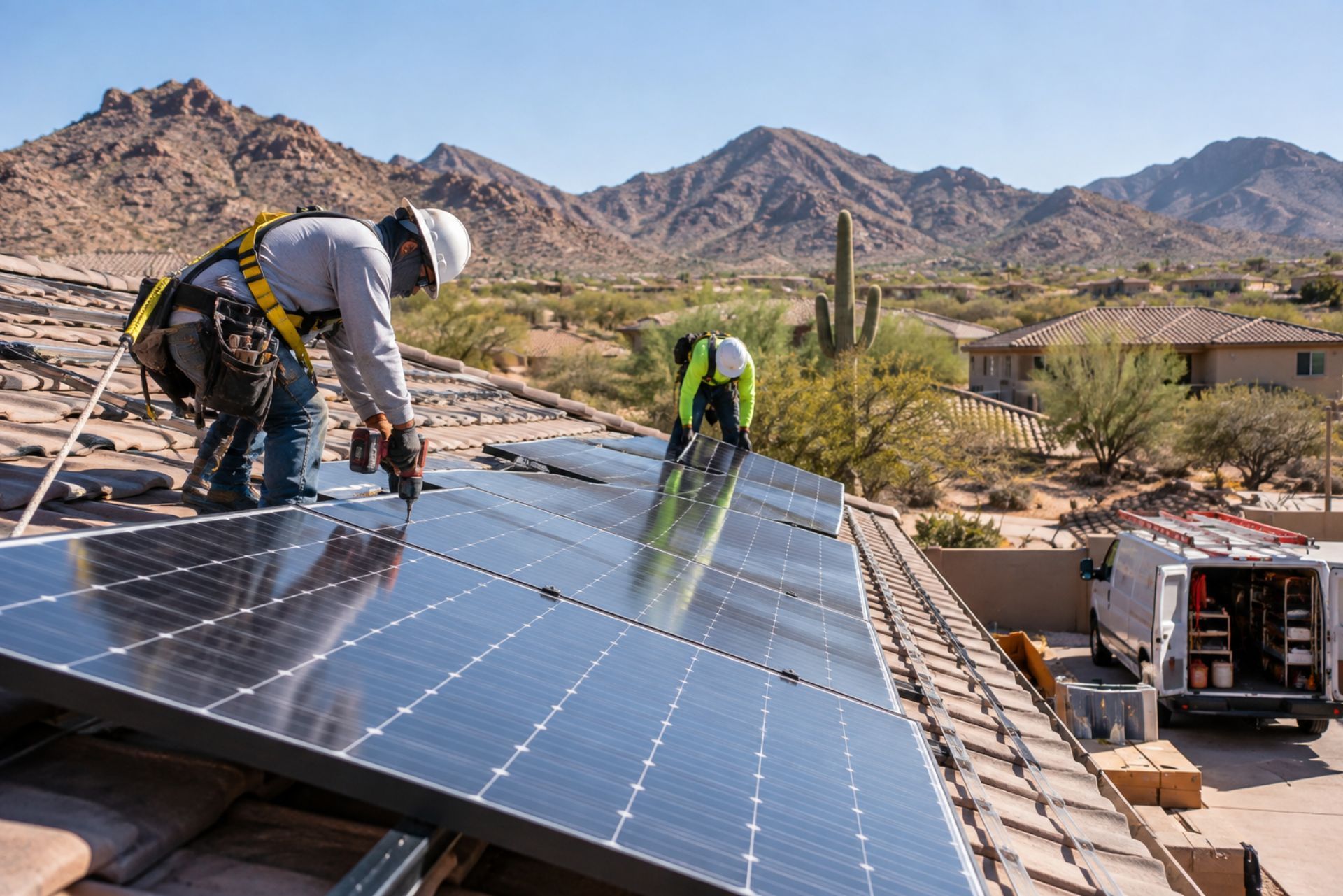
Residential and commercial solar work carry different risk profiles, and your insurance should reflect that. A residential crew installing 20-panel systems on single-family homes faces different exposures than a team wiring a 500kW commercial array on a warehouse roof.
Commercial projects typically involve higher contract values, more stringent certificate requirements from general contractors, and greater property damage exposure. You'll often need higher liability limits - $2 million or even $5 million - and umbrella policies are common requirements for commercial bids.
Residential work, while lower in per-project value, generates higher claim frequency. More job sites mean more opportunities for property damage, more homeowner interactions, and more completed operations exposure across hundreds of individual systems.
Comparison Chart: Basic vs. Extended Solar Coverage
| Coverage Element | Basic (Residential Focus) | Extended (Commercial Focus) |
|---|---|---|
| General Liability | $1M/$2M limits | $2M/$4M or higher |
| Completed Operations | Included in GL | Higher sub-limits, longer tail |
| Inland Marine | $50K-$100K blanket | $250K+ with scheduled items |
| Workers' Comp | State minimum compliance | Enhanced with safety program credits |
| Professional Liability | Often not carried | $1M+ recommende |
| Umbrella/Excess | Rarely required | $1M-$5M commonly required |
| Estimated Annual Cost | $3,500-$8,000 | $12,000-$30,000+ |
Your actual costs will depend on revenue, payroll, claims history, and project types. But this chart gives you a realistic baseline for budgeting.
Factors Influencing Solar Insurance Costs in Arizona
Insurance pricing for solar contractors isn't random - it's driven by specific, measurable risk factors. Understanding what moves the needle helps you control costs and avoid sticker shock at renewal.
How Revenue and Payroll Impact Premiums
General liability premiums are typically calculated based on your annual revenue, while workers' comp premiums are driven by payroll. A solar company generating $500,000 in annual revenue will pay significantly less for GL than one doing $3 million. Insurance costs for solar panel installation businesses vary widely, but most small to mid-size Arizona installers should expect to spend between 2% and 5% of revenue on their total insurance package.
Workers' comp rates are expressed per $100 of payroll. With Arizona's continued rate decreases, current base rates remain competitive compared to neighboring states like California and Nevada. That said, your experience modification rate (EMR) can push your actual premium well above or below the base rate. A clean claims history with an EMR below 1.0 saves you real money every year.
Roof Access and Height Risk Assessments
Rooftop work is the single biggest rating factor that separates solar installers from other electrical contractors. Insurers classify roof access work at a higher hazard level, and your premiums reflect that. The height of the structures you work on, whether you're on pitched residential roofs versus flat commercial rooftops, and your fall protection protocols all factor into underwriting decisions.
Documenting your safety program - harness requirements, ladder protocols, heat illness prevention, and OSHA compliance - gives underwriters confidence and can meaningfully reduce your rates. Arizona contractor insurance costs tend to be moderate compared to coastal states, but rooftop solar work still commands premium rates within the electrical trade classification.
Common Questions About Solar Installation Insurance
FAQ: What Arizona Solar Pros Need to Know
Do I need insurance if I subcontract all my labor? Yes. Even if you use subcontractors exclusively, you need your own general liability policy. If a sub doesn't carry adequate insurance, their claims can flow up to you. Always verify sub certificates before they start work.
Can I bundle all my coverages into one policy? Most coverages can be combined into a Business Owner's Policy (BOP) or a contractor's package, but workers' comp is always a separate policy. Working with a specialty program like Joule Pro ensures your package is structured correctly for solar-specific risks.
What happens if I work in multiple Arizona counties? Your insurance follows you statewide. You don't need separate policies for different counties, but make sure your policy territory includes all areas where you operate.
How does my claims history affect future premiums? Claims within the past three to five years directly impact your experience modification rate and your ability to get competitive quotes. Even small claims can increase your EMR, so consider the long-term cost before filing minor claims.
Is commercial auto insurance required for my work trucks? Arizona requires liability coverage on all vehicles. If your trucks carry tools, panels, or equipment, you'll want comprehensive and collision coverage plus adequate cargo limits, which ties back to your inland marine policy.
Does my insurance cover warranty work? Standard policies don't cover the cost of redoing your own work. They cover damage caused by faulty work to other property, but not the rework itself. Read your exclusions carefully.
Making the Right Choice for Your Solar Business
Arizona's solar market rewards contractors who are properly licensed, adequately insured, and prepared for the specific risks of rooftop electrical work. The right insurance program protects your crew, your equipment, your clients, and ultimately your ability to keep bidding and winning work.
Don't settle for a generic contractor policy from an agent who doesn't understand solar installation risks. The difference between proper coverage and a policy full of gaps often only becomes visible after a claim - and by then, it's too late to fix. A specialty insurance partner with direct underwriter relationships in the electrical trade can structure a program that fits your actual operations, not a one-size-fits-all template.
If you're starting a new solar operation, scaling up from residential to commercial, or simply due for a policy review, take the time to get quotes from providers who specialize in your trade. Your insurance should work as hard as your crew does on those Arizona rooftops.

Founder & CEO
The Force Behind the Program
About the Author:
Michael Fusco.
Fusco Orsini & Associates
Joule Pro exists because Mike Fusco saw electrical contractors getting boilerplate insurance — and built a program designed for the way the trade actually works.
Mike is the CEO and co-founder of Fusco Orsini & Associates, the San Diego–based independent agency he launched in 2010. Under his leadership FOA has grown into a nationwide partner serving clients across 31 states, with a personal, client-first approach to commercial insurance and risk.
With over 20 years in insurance and risk management, he specializes in tailored programs spanning general liability, workers' compensation, surety bonding, and employee benefits — helping owners confidently manage risk and pursue growth.
Mike holds a B.S. in Business from the University of Maryland — Robert H. Smith School of Business, and the Certified Insurance Counselor (CIC) designation, held by fewer than 3% of insurance professionals nationwide.
What Our Clients Say
Trusted by Electrical Contractors Across the Country.
5.0
★★★★★
Google reviews
Core Commercial Coverage
Business Insurance for Electrical Contractors.
The fundamentals — written, structured, and priced for electrical risk. Each line is reviewed annually by an underwriter who only writes our trade.
01
General Liability
Premises & completed-operations coverage with electrical-specific endorsements and full pollution carve-back options.
02
Workers' Compensation
Class-code optimization, experience-mod review, and return-to-work programs designed for energized-work exposures.
03
Commercial Auto
Fleet, hired & non-owned auto, and tools-in-transit coverage written for service vans and bucket trucks.
04
Tools & Equipment
Scheduled and blanket coverage for tools, test equipment, scissor lifts, and contractor's equipment on-site or in-transit.
05
Surety Bonds
Bid, performance, and payment bonds — single-job and aggregate programs for commercial & public-works contracts.
06
Commercial Property
Layered limits up to $50M with carrier panels covering your shop, warehouse, yard, and on-premises tools, materials, and equipment.
Who We Serve
Electrical Contractors We Specialize In.
From $5M service shops to $250M industrial primes — every Joule Pro program is shaped to the contractor's revenue mix and project profile.
01 / Industrial
Commercial & Industrial Electrical Contractors
High-voltage, substation, and plant electrical work. Pollution, builder's risk, and large-deductible WC programs.
02 / Service
Service & Residential Electrical Contractors
Service-call shops, panel upgrades, and EV charging installers. Auto-fleet, GL, and tool-coverage programs.
03 / Low-Voltage
Specialty & Low-Voltage Contractors
Data, fire-alarm, security, and BMS controls. Cyber, professional liability, and follow-form excess.
Frequently Asked Questions
Common
Questions From
Electrical Contractors.
What size electrical contractors do you write?
Joule Pro is built for licensed electrical firms from roughly $2M in revenue to $250M+. Below $2M we typically refer to our small-business desk; above $250M we underwrite individually with our industrial practice team.
Do I need to be licensed in multiple states?
No. We license you wherever you work. Joule Pro is admitted in 31 states and our compliance team handles multi-state filings, prevailing-wage endorsements, and certificate-of-insurance requirements.
How is Joule Pro different from a generic contractor program?
Generic programs use a contractor's questionnaire that treats you like a roofer. We use forms written for energized work, arc-flash exposures, and design-build risk — and our carriers price accordingly.
What does the claims process actually look like?
Every Joule Pro client is assigned a named claims advocate at bind. They take the FNOL, set strategy with your assigned attorney, and serve as your single point of contact through close.
Can you bond large public-works contracts?
Yes. Through our surety partners we write single-job bonds up to $75M and aggregate programs to $300M, with expedited turnarounds for school district, federal, and DOT work.
What happens at renewal?
Your producer and claims advocate jointly run a renewal review 90 days out — covering loss trends, exposure changes, and market alternatives — so renewal day is a confirmation, not a surprise.
From the Blog
Insights for Electrical Contractors.
Risk briefings, claim post-mortems, and program updates — written by our underwriters and risk engineers.


Get Started
Get a Quote on a Program Built Around Your Trade.
A 30-minute discovery call is the only commitment. You'll leave with a written gap analysis of your current program — yours to keep, whether you bind with us or not.