Business Insurance
Smart Home and Automation Installer Insurance
★★★★★ 150+ Five-Star Reviews · Google & Facebook
A single misrouted wire behind a client's wall can trigger a $50,000 insurance claim before lunch. A smart thermostat that locks out a home's HVAC system during a heat wave? That's a lawsuit waiting to happen. Smart home and home automation installers face a unique collision of electrical work, networked technology, and client expectations that most standard contractor policies weren't designed to cover. The work blurs the line between traditional electrical contracting and IT services, and the insurance needs to reflect that overlap.
Whether you're running low-voltage cable for a whole-home audio system or configuring a client's security cameras to talk to their door locks, you're carrying risk that a general electrician doing panel upgrades simply doesn't. Your tools are expensive, your vehicles are packed with inventory, and the systems you install touch everything from a homeowner's Wi-Fi network to their door locks. Getting the right mix of coverage - general liability, professional liability, tools and equipment protection, commercial auto, workers' comp, and proper certificates - isn't optional. It's the difference between a business that survives a bad day and one that doesn't.
This is the reality for thousands of automation installers across the U.S. in 2026, and the insurance market has finally started catching up with the risks you actually carry.
Why Smart Home Installers Need Specialized Protection
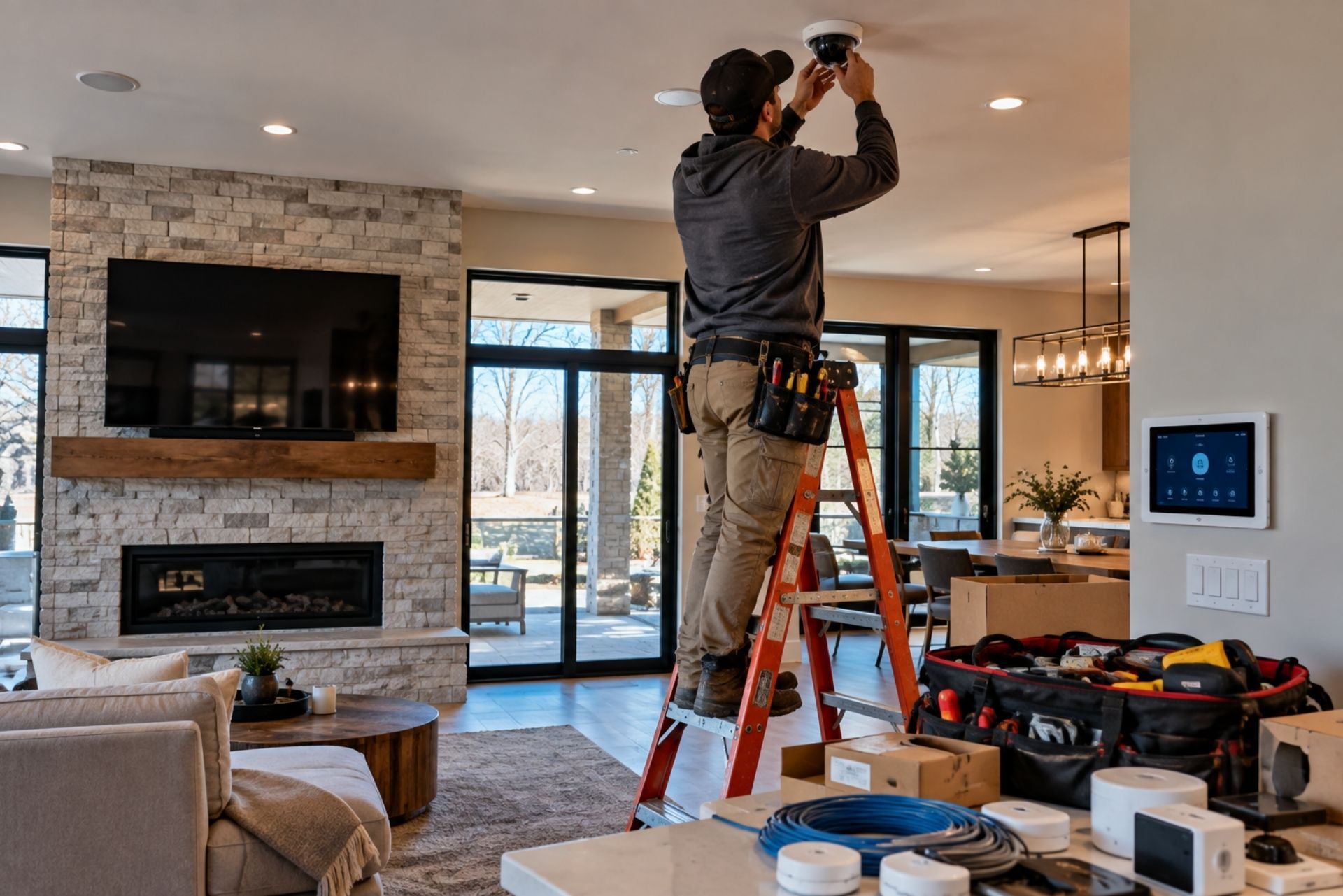
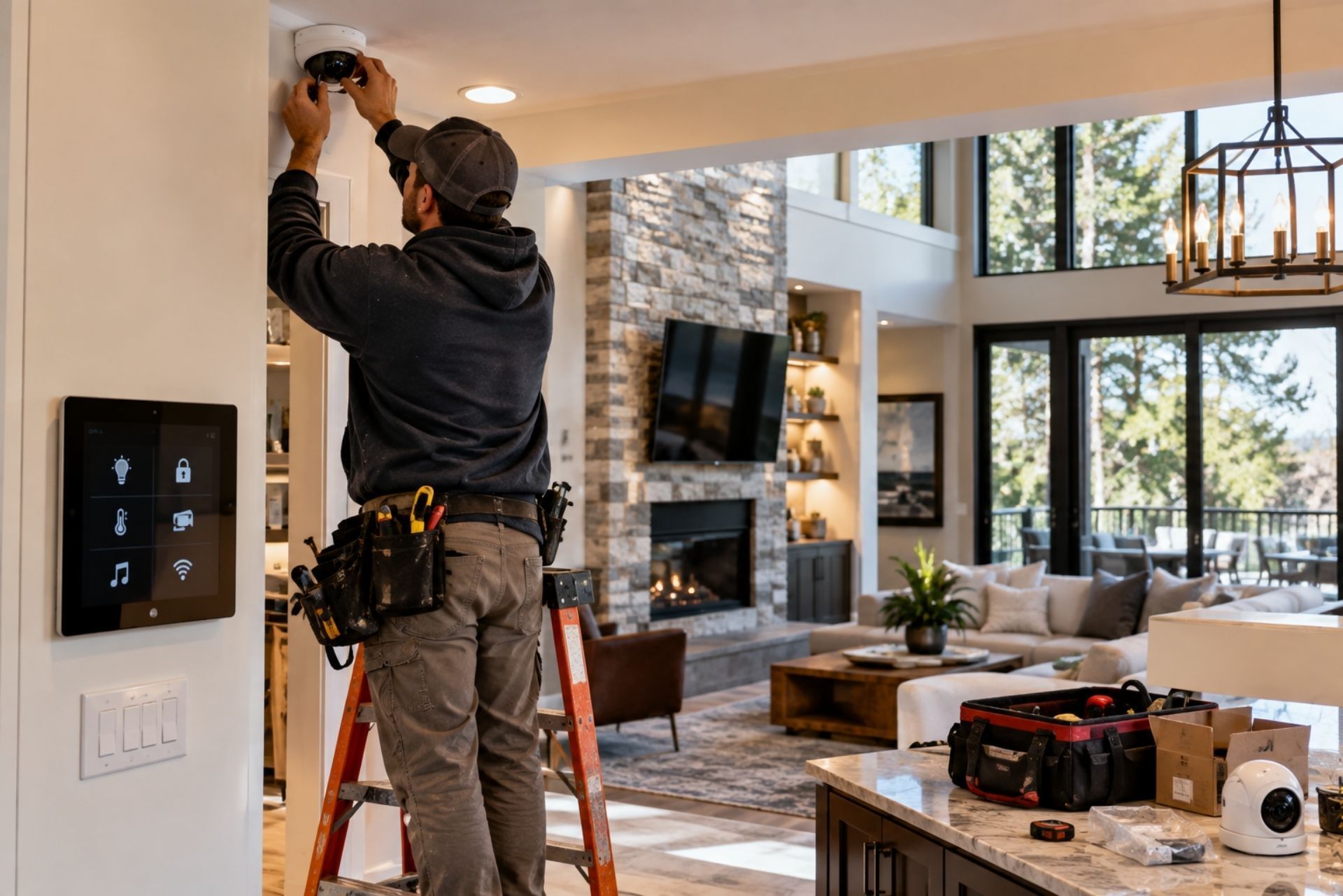
Home automation work sits at an unusual intersection. You're doing physical installation work (drilling, pulling wire, mounting hardware) while also configuring software, integrating cloud-based systems, and handling sensitive client data. A standard electrician's GL policy might cover the hole you accidentally drilled through a water pipe, but it probably won't cover the fallout from a botched integration that leaves a client's security system offline for a week.
High-Value Hardware and Liability Risks
The gear you install is expensive. A single Lutron RadioRA 3 system for a mid-range home can run $15,000 to $30,000 in hardware alone. If a power surge damages equipment you installed because of a wiring error, that's your problem. If a client's $8,000 motorized shade system stops working three months after install and they claim faulty workmanship, you need coverage that addresses the completed operations exposure, not just what happens while you're on-site.
The physical risks are real too. Installers work on ladders, in attics, and inside walls. A tech who falls through a ceiling or drops a speaker on a marble floor creates an immediate liability event.
Network Security and Data Privacy Concerns
Here's where smart home work diverges sharply from traditional electrical contracting. You're often connecting to a client's home network, configuring IP addresses, setting up remote access, and sometimes handling credentials for security cameras that stream inside their home. If that network gets compromised because of a configuration error you made, or if a client's private camera footage leaks, the liability exposure is significant.
E&O risks in 2026 are
increasingly driven by digital and AI-assisted workflows, and smart home installers are squarely in that category. You're not just pulling wire anymore; you're building connected systems that carry data privacy implications.

By: Michael Fusco
President of Joule Pro
INDEX
Joule Pro is a specialty insurance and risk program of Fusco Orsini & Associates Insurance Services, built exclusively for electrical contractors and licensed in 31 states.
We work with electrical firms across the country — from California, Texas, Florida, New York, and coast to coast — placing General Liability, Workers' Compensation, Commercial Auto, Inland Marine, Surety Bonds, Excess Liability, and full specialty coverage stacks for commercial, industrial, service, residential, and low-voltage electrical contractors. Joule Pro is not a separate licensed entity. It is a dedicated program structure inside Fusco Orsini, giving electrical contractors access to specialty carriers, in-house claims advocacy, and trade-specific risk engineering under one program.
Core Insurance Policies for Automation Professionals
The right insurance stack for a home automation installer looks different from a standard electrical contractor's package. You need the usual foundation, but with specific additions that reflect the technology-driven nature of your work.
General Liability for Physical Damage
General liability is your baseline. It covers bodily injury and property damage that happens during or because of your work. Think: a client trips over your cable run and breaks a wrist, or your drill punctures a gas line.
State requirements for GL minimums vary significantly - Washington requires $200,000 through L&I, while Utah mandates $100,000/$300,000 for licensing. Most commercial clients and general contractors will require you to carry at least $1 million per occurrence regardless of state minimums. If you're doing any residential work in affluent markets, $2 million aggregate is increasingly the expectation.
Professional Liability and Errors & Omissions (E&O)
This is the coverage most automation installers underestimate. E&O protects you when your work product fails - not because of physical damage, but because of a design flaw, a programming error, or a miscommunication about system capabilities. A client who expected their new system to integrate with their existing HVAC but finds out post-install that it doesn't? That's an E&O claim.
E&O also covers you if a system you programmed malfunctions and causes a loss. Say your automated lighting schedule fails and a vacation home sits dark for two weeks, leading to a break-in. The homeowner's insurer may come after you.
Cyber Liability for Connected Systems
Cyber liability is the newest addition to the automation installer's coverage stack, and it's becoming harder to skip. If you configure a client's smart home hub and a vulnerability in your setup leads to a data breach, cyber liability responds where GL and E&O won't. This is especially relevant for installers working with security cameras, smart locks, and access control systems.
Policies typically cover breach notification costs, legal defense, and regulatory fines. For a small installation company with revenue under $500,000, annual premiums in 2026 typically range from $500 to $1,200 depending on revenue and the scope of connected systems you handle (https://insura.ai/insurance/cyber-liability-insurance-cost).
Comparing General vs. Professional Liability
One of the most common mistakes I see with automation installers is assuming their general liability policy covers everything. It doesn't. GL and professional liability (E&O) cover fundamentally different types of claims, and you likely need both.
Comparison Table: Coverage Differences at a Glance
| Scenario | General Liability | Professional Liability (E&O) |
|---|---|---|
| Tech drops a tool on a client's hardwood floor | Covered | Not covered |
| Client slips on cable left in walkway | Covered | Not covered |
| System you designed doesn't perform as promised | Not covered | Covered |
| Programming error causes HVAC system failure | Not covered | Covered |
| Faulty wiring causes a small fire | Covered | Not covered |
| Client claims you recommended the wrong equipment | Not covered | Covered |
| Subcontractor injures a homeowner's pet | Covered (with sub coverage) | Not covered |
The pattern is clear: GL handles physical incidents, while E&O handles professional mistakes and performance failures. Smart home installers who only carry GL are exposed every time a system doesn't work as the client expected.
Protecting Your Tools and Business Assets
Your tools, test equipment, and vehicle inventory represent a significant investment. A loaded service van can easily carry $10,000 to $25,000 in equipment on any given day, and a theft or accident can shut down your operation overnight.
Inland Marine Insurance for Equipment in Transit
Standard commercial property policies typically protect your stuff at your shop or office. The moment that equipment goes into a van and heads to a job site, you need inland marine coverage to fill the gap. Inland marine "floaters" are specifically designed to protect tools and equipment while in transit or at temporary job locations.
For automation installers, this is critical. You're carrying network switches, wire reels, tablets, oscilloscopes, and sometimes client hardware that hasn't been installed yet. A van break-in at a job site or a rear-end collision can wipe out tens of thousands in equipment. Joule Pro structures inland marine coverage specifically for electrical contractors, which means the policy language actually reflects the type of equipment you carry rather than generic tool lists.
Commercial auto insurance deserves attention here too. In 2026, commercial auto rates remain volatile because repairing modern service vehicles with sensors and cameras has become significantly more expensive. Your best strategy for controlling premiums is documenting safety programs and driver monitoring rather than just shopping for the lowest quote.
Workers' Compensation for Installation Teams
If you have employees, workers' comp isn't optional in most states. The good news for low-voltage automation installers is that rates tend to be more favorable than general electrical wiring. In Florida, for example, the 2026 rate for NCCI Code 5191 (low-voltage work) sits at $0.83 per $100 of payroll, compared to $2.97 for general electrical wiring. That's a meaningful difference if you can get your work properly classified.
The catch is classification. If your crew does both low-voltage automation work and traditional electrical work, the higher rate may apply to the entire payroll unless you can clearly document the split. This is one area where working with a specialty program like Joule Pro matters: they understand the classification nuances for electrical contractors and can help ensure your payroll is coded correctly.
Common Questions About Smart Home Insurance
FAQ: What You Need to Know
Do I need separate insurance for smart home work if I already have an electrician's policy? Maybe. If your existing GL policy covers low-voltage and technology installation, you might be fine on the liability side. But you almost certainly need to add E&O coverage, which most standard electrician policies don't include.
What's a certificate of insurance, and why do clients keep asking for one? A certificate of insurance (COI) is a one-page document proving you carry active coverage. General contractors, property managers, and HOAs routinely require them before allowing you on-site. Your insurer or agent can issue them quickly, often same-day.
Does my personal auto insurance cover my work van? No. Personal auto policies exclude vehicles used for business purposes. You need a commercial auto policy, and if your van carries tools and inventory, you need inland marine coverage on top of that.
How much does insurance for a small automation company typically cost? Costs vary by coverage type; for instance, the median annual cost for General Liability for installation professionals is $1,020 for a $1M/$2M policy (https://www.insureon.com/installation-business-insurance/cost). Adding E&O and cyber liability pushes that higher, but the cost of going without either one is far greater if a claim hits.
Can I reduce my workers' comp costs by classifying all my work as low-voltage? Only if it's accurate. Misclassifying payroll is audit fraud and can result in back-premiums, penalties, and policy cancellation. If your crew does mixed work, document the hours carefully and work with an agent who understands electrical trade classifications.
Making the Right Choice for Your Business
Smart home and automation installation is one of the fastest-growing segments in the electrical trades, and the insurance market is still catching up. The installers who protect themselves best are the ones who recognize that their work carries both physical and technology-related risks, and who build a coverage stack that addresses both.
Start with a solid general liability policy that meets your state's requirements and your clients' certificate expectations. Add E&O coverage to protect against the professional liability claims that come with system design and programming. Protect your tools with inland marine coverage, get proper commercial auto for your fleet, and make sure your workers' comp classifications reflect the actual work your crew performs.
Joule Pro specializes in exactly this kind of coverage for licensed electrical contractors, including those doing automation and low-voltage work. Having a direct conversation with a licensed insurance professional who understands the electrical trades is worth more than any online quote tool. Reach out, get your coverage reviewed, and make sure your policy matches the work you're actually doing today.

Founder & CEO
The Force Behind the Program
About the Author:
Michael Fusco.
Fusco Orsini & Associates
Joule Pro exists because Mike Fusco saw electrical contractors getting boilerplate insurance — and built a program designed for the way the trade actually works.
Mike is the CEO and co-founder of Fusco Orsini & Associates, the San Diego–based independent agency he launched in 2010. Under his leadership FOA has grown into a nationwide partner serving clients across 31 states, with a personal, client-first approach to commercial insurance and risk.
With over 20 years in insurance and risk management, he specializes in tailored programs spanning general liability, workers' compensation, surety bonding, and employee benefits — helping owners confidently manage risk and pursue growth.
Mike holds a B.S. in Business from the University of Maryland — Robert H. Smith School of Business, and the Certified Insurance Counselor (CIC) designation, held by fewer than 3% of insurance professionals nationwide.
What Our Clients Say
Trusted by Electrical Contractors Across the Country.
5.0
★★★★★
GOOGLE REVIEWS
Core Commercial Coverage
Business Insurance for Electrical Contractors.
The fundamentals — written, structured, and priced for electrical risk. Each line is reviewed annually by an underwriter who only writes our trade.
01
General Liability
Premises & completed-operations coverage with electrical-specific endorsements and full pollution carve-back options.
02
Workers' Compensation
Class-code optimization, experience-mod review, and return-to-work programs designed for energized-work exposures.
03
Commercial Auto
Fleet, hired & non-owned auto, and tools-in-transit coverage written for service vans and bucket trucks.
04
Tools & Equipment
Scheduled and blanket coverage for tools, test equipment, scissor lifts, and contractor's equipment on-site or in-transit.
05
Surety Bonds
Bid, performance, and payment bonds — single-job and aggregate programs for commercial & public-works contracts.
06
Commercial Property
Layered limits up to $50M with carrier panels covering your shop, warehouse, yard, and on-premises tools, materials, and equipment.
Who We Serve
Electrical Contractors We Specialize In.
From $5M service shops to $250M industrial primes — every Joule Pro program is shaped to the contractor's revenue mix and project profile.
01 / Industrial
Commercial & Industrial Electrical Contractors
High-voltage, substation, and plant electrical work. Pollution, builder's risk, and large-deductible WC programs.
02 / Service
Service & Residential Electrical Contractors
Service-call shops, panel upgrades, and EV charging installers. Auto-fleet, GL, and tool-coverage programs.
03 / Low-Voltage
Specialty & Low-Voltage Contractors
Data, fire-alarm, security, and BMS controls. Cyber, professional liability, and follow-form excess.
Frequently Asked Questions
Common
Questions From
Electrical Contractors.
What size electrical contractors do you write?
Joule Pro is built for licensed electrical firms from roughly $2M in revenue to $250M+. Below $2M we typically refer to our small-business desk; above $250M we underwrite individually with our industrial practice team.
Do I need to be licensed in multiple states?
No. We license you wherever you work. Joule Pro is admitted in 31 states and our compliance team handles multi-state filings, prevailing-wage endorsements, and certificate-of-insurance requirements.
How is Joule Pro different from a generic contractor program?
Generic programs use a contractor's questionnaire that treats you like a roofer. We use forms written for energized work, arc-flash exposures, and design-build risk — and our carriers price accordingly.
What does the claims process actually look like?
Every Joule Pro client is assigned a named claims advocate at bind. They take the FNOL, set strategy with your assigned attorney, and serve as your single point of contact through close.
Can you bond large public-works contracts?
Yes. Through our surety partners we write single-job bonds up to $75M and aggregate programs to $300M, with expedited turnarounds for school district, federal, and DOT work.
What happens at renewal?
Your producer and claims advocate jointly run a renewal review 90 days out — covering loss trends, exposure changes, and market alternatives — so renewal day is a confirmation, not a surprise.
From the Blog
Insights for Electrical Contractors.
Risk briefings, claim post-mortems, and program updates — written by our underwriters and risk engineers.


Get Started
Get a Quote on a Program Built Around Your Trade.
A 30-minute discovery call is the only commitment. You'll leave with a written gap analysis of your current program — yours to keep, whether you bind with us or not.