
Business Insurance
Whole-Home Rewiring Contractor Insurance
★★★★★ 150+ Five-Star Reviews · Google & Facebook
A single house fire traced back to faulty wiring can generate a claim that exceeds six figures before the homeowner's attorney even files suit. For electrical contractors who specialize in whole-home rewiring, the risk profile looks nothing like a standard service-call operation. You're opening walls, pulling permits, running hundreds of feet of new wire through occupied homes, and leaving behind work that must perform safely for decades. The insurance you carry needs to reflect that reality, covering everything from general liability and fire-related completed operations claims to your tools, vehicles, and crew.
The 2026 NEC introduces
significant changes to load calculations and new requirements for EV charging infrastructure, which means rewiring projects are getting more complex, not less. More complexity means more exposure. Whether you're a one-truck operation or running multiple crews, understanding the full coverage stack for
rewiring contractor insurance - general liability, completed operations,
tools and equipment,
commercial auto, workers' comp, and certificates - isn't optional. It's the difference between surviving a bad claim and closing your doors.
Why Whole-Home Rewiring Requires Specialized Coverage
Rewiring an entire home is one of the most invasive electrical projects a residential contractor can take on. You're not swapping a panel or adding a circuit. You're threading new conductors through walls, ceilings, and floors, often in older homes with knob-and-tube or aluminum wiring that carries its own hazards. The scope of work touches nearly every room, and the potential for property damage or injury is present at every stage.
A standard electrician's liability policy might cover basic service work, but it often falls short for full rewiring projects. Insurers evaluate risk based on the type of work you perform, and whole-home rewires sit in a higher risk tier than outlet replacements or fixture installs.
Managing High-Liability Risks in Residential Electrical Work
Fire is the headline risk. A loose connection behind drywall might not cause problems for months or even years, but when it does, the resulting fire can destroy a home. Claims like these fall under your completed operations coverage, and in many states, homeowners can file construction defect claims for up to ten years after a project is finished due to statutes of repose. That's a long tail of liability for work you may have forgotten about.
Beyond fire, there's the risk of electrocution, damage to plumbing or HVAC systems hidden in walls, and even mold from water intrusion at penetration points. Each of these scenarios requires a policy that's been structured for the actual work you do, not a generic contractor policy with electrical work checked as a box.
The Difference Between Service Calls and Major Projects
A service call to troubleshoot a tripping breaker might take an hour. A whole-home rewire takes days or weeks, involves multiple inspections, and often requires coordination with drywall, painting, and sometimes plumbing trades. Your exposure per project is dramatically higher.
Insurers care about this distinction. Your annual revenue from rewiring projects versus service work affects your premium, your coverage limits, and which endorsements you need. If you're doing mostly rewires but your policy is rated for general electrical service, you could face a coverage gap right when you need it most. Programs like Joule Pro exist specifically because generalist agencies often miss these nuances for electrical contractors.

By: Michael Fusco
President of Joule Pro
INDEX
Joule Pro is a specialty insurance and risk program of Fusco Orsini & Associates Insurance Services, built exclusively for electrical contractors and licensed in 31 states.
We work with electrical firms across the country — from California, Texas, Florida, New York, and coast to coast — placing General Liability, Workers' Compensation, Commercial Auto, Inland Marine, Surety Bonds, Excess Liability, and full specialty coverage stacks for commercial, industrial, service, residential, and low-voltage electrical contractors. Joule Pro is not a separate licensed entity. It is a dedicated program structure inside Fusco Orsini, giving electrical contractors access to specialty carriers, in-house claims advocacy, and trade-specific risk engineering under one program.
Essential Insurance Policies for Electrical Contractors
Building the right coverage stack means understanding what each policy actually protects and where the gaps hide. Here's how the core policies apply to rewiring work specifically.
General Liability and Property Damage Protection
Commercial general liability (CGL) is your foundation. It covers third-party bodily injury and property damage that occurs during your operations. If a homeowner trips over your cable run and breaks a wrist, or if you accidentally drill into a water line, CGL responds.
For rewiring contractors, the property damage component matters most. You're working inside someone's home, often with the family still living there. Accidental damage to flooring, cabinetry, or personal property is a realistic scenario on nearly every job. Your CGL limits should reflect the value of the homes you work in, not just the minimum your state requires.
One emerging concern: the new ISO endorsement CG 40 47 01 26, which became widely effective on January 1, 2026, now excludes claims arising from generative AI. If you're using AI-based tools for load calculations, circuit diagnostics, or project estimating, and those tools contribute to a project failure, your CGL policy may not cover the resulting claim. This is new territory in 2026, and worth discussing with your agent.
Professional Liability for Design and Consultation Errors
General liability covers physical damage. Professional liability (sometimes called errors and omissions) covers mistakes in your professional judgment: a panel design that doesn't meet code, a load calculation error, or a recommendation that leads to a system failure.
If you design electrical layouts, specify equipment, or advise homeowners on system capacity, professional liability fills a gap that CGL won't touch. This is especially relevant for rewiring contractors who are often making design decisions about circuit allocation, panel sizing, and EV charging readiness under the 2026 NEC's reorganized load calculation framework.
Workers' Compensation for High-Risk Environments
Electrical work consistently ranks among the most dangerous construction trades. Workers' comp is mandatory in nearly every state once you have employees, and the classification codes for electrical contractors reflect the elevated risk.
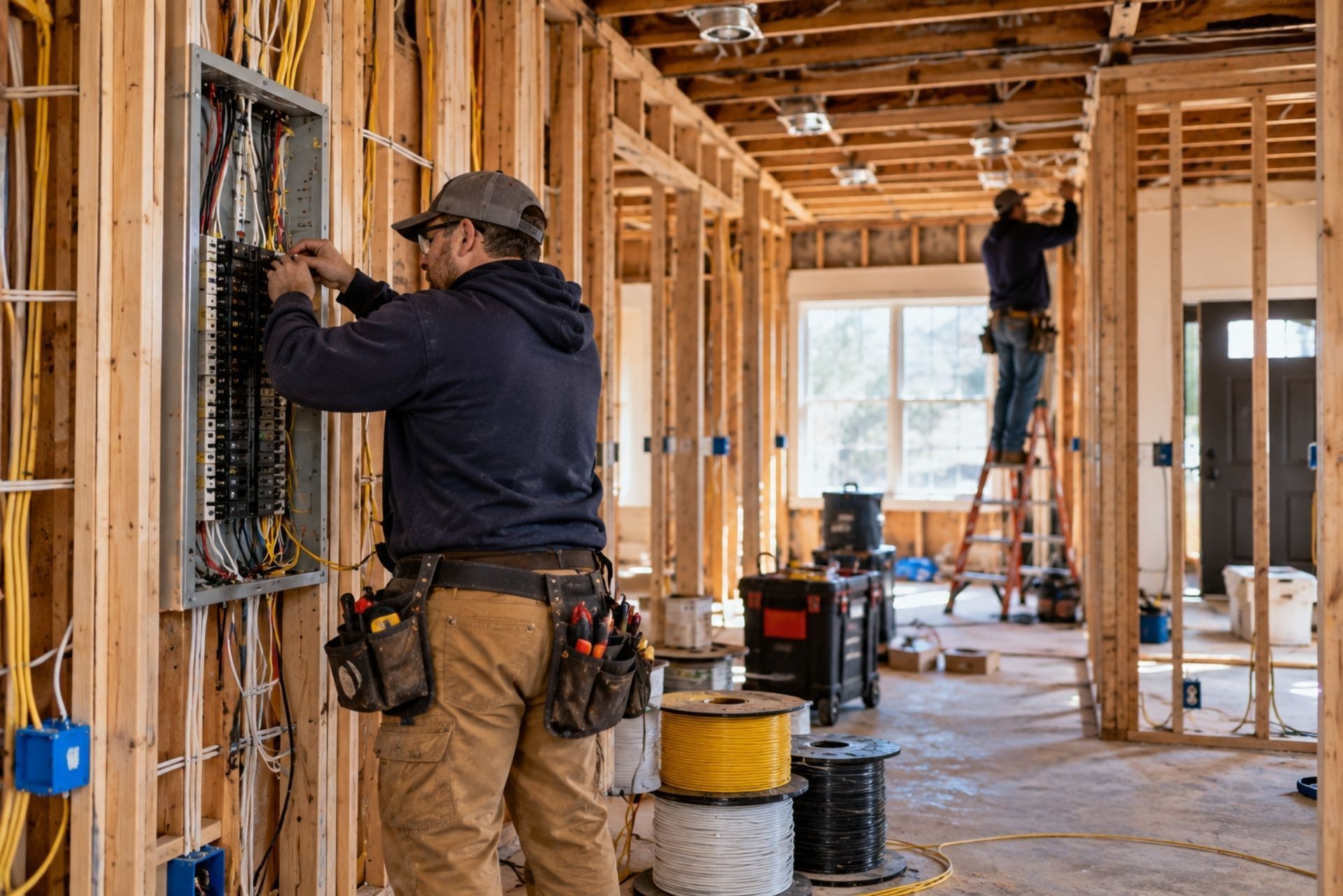
Whole-home rewiring adds specific hazards: working in attics during summer heat, crawling through tight crawl spaces, handling live circuits during panel transitions, and climbing ladders in occupied homes. Your workers' comp policy needs to accurately reflect your payroll and job classifications. Misclassifying employees or underreporting payroll is one of the fastest ways to trigger an audit surcharge.
Comparing Coverage Needs: Basic vs. Comprehensive
Not every rewiring contractor needs the same coverage, but most need more than they think. The difference between a basic policy and a comprehensive one often shows up only after a claim.
Comparison Table: Standard vs. Extended Coverage Features
| Coverage Feature | Standard Policy | Extended / Comprehensive |
|---|---|---|
| General Liability | $1M per occurrence / $2M aggregate | Higher limits, broader triggers |
| Completed Operations | 1-2 years post-completion | Full statute of repose period (up to 10 years) |
| Professional Liability | Not included | Included for design and consultation errors |
| Tools & Equipment | Limited or scheduled only | Blanket coverage with replacement cost |
| Commercial Auto | Liability only | Liability + comprehensive + cargo |
| Workers' Comp | State minimum | Enhanced benefits, return-to-work programs |
| AI Exclusion Awareness | Standard CG 40 47 01 26 exclusion applies | Agent-reviewed; potential endorsements explored |
The right column represents what most rewiring contractors actually need. A specialty program like Joule Pro, backed by Fusco Orsini & Associates Insurance Services (CA Lic. 0H16057), can help you build this full stack with underwriters who understand electrical trade risks specifically.
Protecting Your Assets: Tools, Equipment, and Vehicles
Your tools and trucks are what make revenue possible. Losing either one to theft, an accident, or a fire can shut down operations for weeks.
Inland Marine Insurance for Specialized Testing Gear
Commercial Auto for Transporting Bulk Wiring Supplies
Common Questions About Rewiring Insurance
How much does insurance cost for a rewiring business? Premiums vary based on your revenue, payroll, claims history, location, and the specific coverages you carry. A small rewiring operation with one crew might pay differently than a multi-crew firm. The best way to get an accurate number is to work with a producer who specializes in electrical contractor insurance and can quote from specialty markets.
Does my policy cover damage to a client's walls during a rewire? Generally, yes. Your CGL policy should cover accidental property damage to a client's home during operations. However, damage that's an expected part of the work, like cutting drywall to access wiring - is typically your responsibility to repair as part of the contract, not an insurance claim.
Do I need extra coverage if I hire subcontractors? Yes. You should require certificates of insurance from every subcontractor and verify their coverage is current. If a sub causes damage or injury and they're uninsured, the claim often flows uphill to you. Your policy may also need a subcontractor endorsement depending on how frequently you use subs.
Is professional liability different from general liability? Completely. General liability covers physical injury and property damage. Professional liability covers financial losses caused by your professional errors or advice. If you design an electrical layout that fails to meet code and the homeowner has to pay for a redesign, that's a professional liability claim, not a general liability one.
What happens if my tools are stolen from a job site? Your inland marine policy would cover this, assuming you have one. Standard business property insurance usually only covers items at your primary business location. If you don't carry inland marine, tool theft at a job site is an out-of-pocket loss. Given that insurers are increasingly using satellite imagery and AI-driven inspections to evaluate risks, documenting your equipment and job site security practices can also help with claims processing.
Making the Right Choice for Your Business
Whole-home rewiring is high-skill, high-trust work. Your clients are handing you the keys to their home and trusting that the wiring behind their walls will be safe for decades. The insurance you carry should match that level of responsibility.
Start by honestly assessing your exposure. How many rewiring projects do you complete per year? What's the average home value? Do you have employees or use subcontractors? Are you using any AI-based tools for estimating or diagnostics? Each answer shapes the coverage you need.
A generalist insurance agent might check the boxes, but electrical contractors face risks that require specialized underwriting. Joule Pro works exclusively with licensed electrical contractors, offering direct producer access so you can talk through your specific operations with someone who understands the difference between a panel swap and a full rewire. That kind of specificity matters when a claim hits and your policy language is all that stands between you and a devastating loss. Get the coverage right now, before you need it.

Founder & CEO
The Force Behind the Program
About the Author:
Michael Fusco.
Fusco Orsini & Associates
Joule Pro exists because Mike Fusco saw electrical contractors getting boilerplate insurance — and built a program designed for the way the trade actually works.
Mike is the CEO and co-founder of Fusco Orsini & Associates, the San Diego–based independent agency he launched in 2010. Under his leadership FOA has grown into a nationwide partner serving clients across 31 states, with a personal, client-first approach to commercial insurance and risk.
With over 20 years in insurance and risk management, he specializes in tailored programs spanning general liability, workers' compensation, surety bonding, and employee benefits — helping owners confidently manage risk and pursue growth.
Mike holds a B.S. in Business from the University of Maryland — Robert H. Smith School of Business, and the Certified Insurance Counselor (CIC) designation, held by fewer than 3% of insurance professionals nationwide.
What Our Clients Say
Trusted by Electrical Contractors Across the Country.
5.0
★★★★★
GOOGLE REVIEWS
Core Commercial Coverage
Business Insurance for Electrical Contractors.
The fundamentals — written, structured, and priced for electrical risk. Each line is reviewed annually by an underwriter who only writes our trade.
01
General Liability
Premises & completed-operations coverage with electrical-specific endorsements and full pollution carve-back options.
02
Workers' Compensation
Class-code optimization, experience-mod review, and return-to-work programs designed for energized-work exposures.
03
Commercial Auto
Fleet, hired & non-owned auto, and tools-in-transit coverage written for service vans and bucket trucks.
04
Tools & Equipment
Scheduled and blanket coverage for tools, test equipment, scissor lifts, and contractor's equipment on-site or in-transit.
05
Surety Bonds
Bid, performance, and payment bonds — single-job and aggregate programs for commercial & public-works contracts.
06
Commercial Property
Layered limits up to $50M with carrier panels covering your shop, warehouse, yard, and on-premises tools, materials, and equipment.
Who We Serve
Electrical Contractors We Specialize In.
From $5M service shops to $250M industrial primes — every Joule Pro program is shaped to the contractor's revenue mix and project profile.
01 / Industrial
Commercial & Industrial Electrical Contractors
High-voltage, substation, and plant electrical work. Pollution, builder's risk, and large-deductible WC programs.
02 / Service
Service & Residential Electrical Contractors
Service-call shops, panel upgrades, and EV charging installers. Auto-fleet, GL, and tool-coverage programs.
03 / Low-Voltage
Specialty & Low-Voltage Contractors
Data, fire-alarm, security, and BMS controls. Cyber, professional liability, and follow-form excess.
Frequently Asked Questions
Common
Questions From
Electrical Contractors.
What size electrical contractors do you write?
Joule Pro is built for licensed electrical firms from roughly $2M in revenue to $250M+. Below $2M we typically refer to our small-business desk; above $250M we underwrite individually with our industrial practice team.
Do I need to be licensed in multiple states?
No. We license you wherever you work. Joule Pro is admitted in 31 states and our compliance team handles multi-state filings, prevailing-wage endorsements, and certificate-of-insurance requirements.
How is Joule Pro different from a generic contractor program?
Generic programs use a contractor's questionnaire that treats you like a roofer. We use forms written for energized work, arc-flash exposures, and design-build risk — and our carriers price accordingly.
What does the claims process actually look like?
Every Joule Pro client is assigned a named claims advocate at bind. They take the FNOL, set strategy with your assigned attorney, and serve as your single point of contact through close.
Can you bond large public-works contracts?
Yes. Through our surety partners we write single-job bonds up to $75M and aggregate programs to $300M, with expedited turnarounds for school district, federal, and DOT work.
What happens at renewal?
Your producer and claims advocate jointly run a renewal review 90 days out — covering loss trends, exposure changes, and market alternatives — so renewal day is a confirmation, not a surprise.
From the Blog
Insights for Electrical Contractors.
Risk briefings, claim post-mortems, and program updates — written by our underwriters and risk engineers.


Get Started
Get a Quote on a Program Built Around Your Trade.
A 30-minute discovery call is the only commitment. You'll leave with a written gap analysis of your current program — yours to keep, whether you bind with us or not.