Business Insurance
Building Automation Systems Contractor Insurance
★★★★★ 150+ Five-Star Reviews · Google & Facebook
A building automation systems (BAS) contractor who wires a faulty sensor into a commercial HVAC network can trigger cascading failures across an entire facility: frozen pipes, spoiled inventory, or a building that overheats in the middle of July. The insurance needs for this work go well beyond what a standard electrician's policy covers. BAS contractors sit at a unique crossroads of electrical installation, software programming, and
network integration, and each of those disciplines carries its own set of risks. If your firm designs, installs, or maintains building automation systems, you need a coverage stack that accounts for general liability, professional liability, completed operations,
tools and equipment,
commercial auto, and the certificates that prove it all to your clients. Getting this right isn't just about protecting your business: it's often the difference between winning a contract and losing it. Building automation is
rapidly becoming a key driver of energy efficiency, operational reliability, and regulatory compliance, which means the stakes on every project keep climbing. Here's what BAS contractors actually need to know about structuring their insurance program in 2026.
Understanding Risk in Building Automation Systems
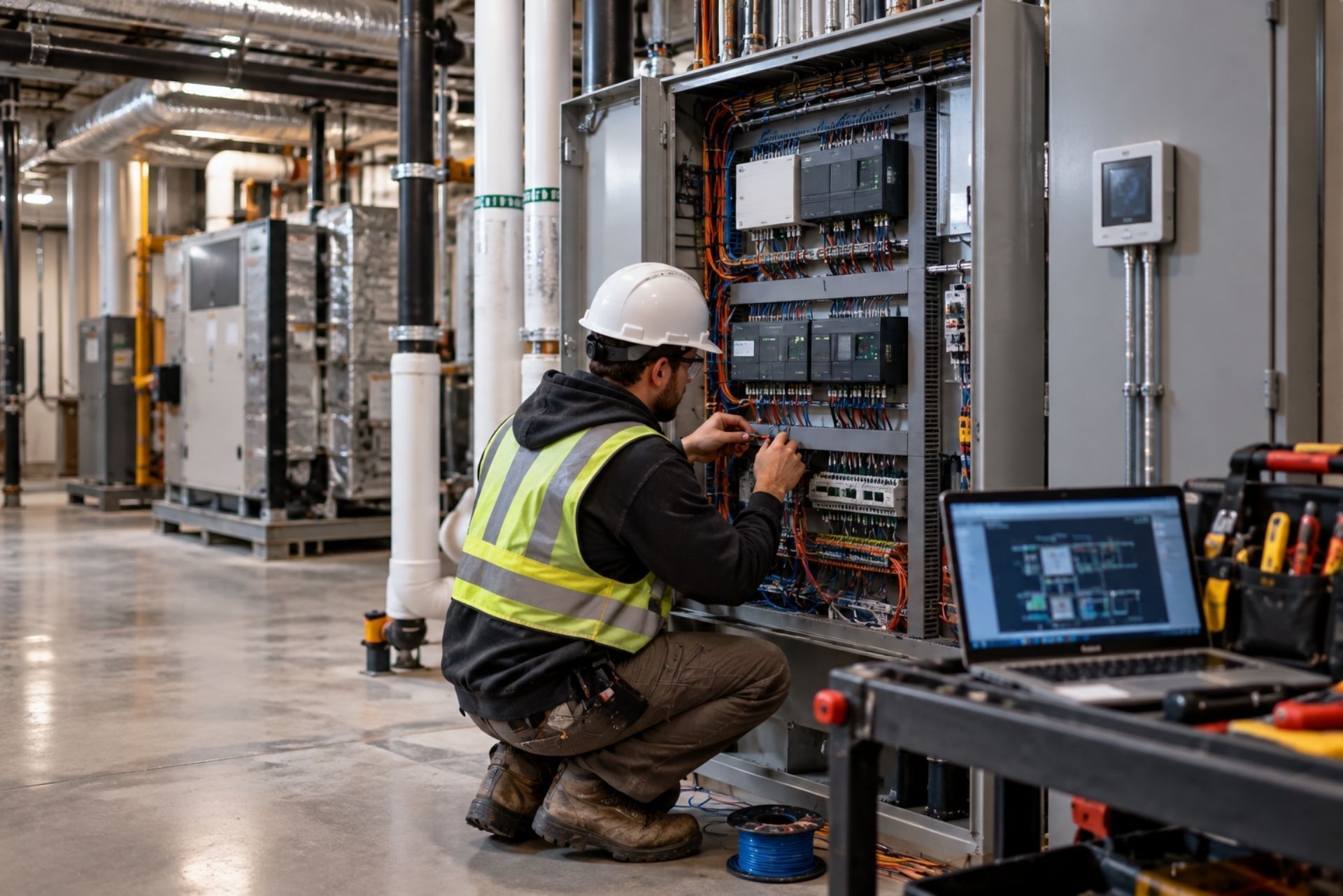
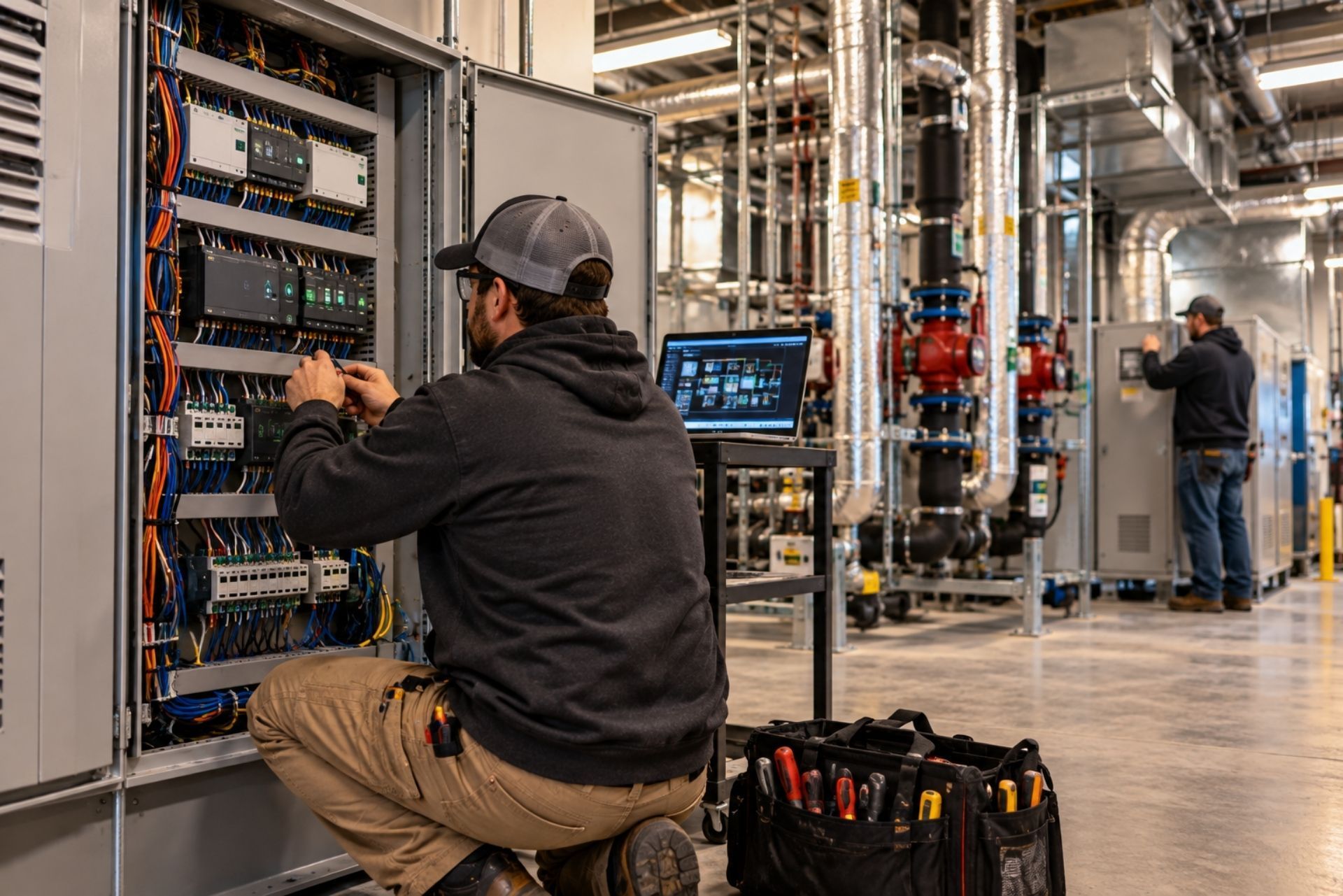
BAS work is fundamentally different from pulling wire through conduit. You're installing physical hardware, yes, but you're also configuring software that controls a building's critical systems: heating, cooling, lighting, access control, fire suppression. A misconfigured control loop doesn't just trip a breaker. It can cause a chiller to run nonstop for 72 hours, flooding a server room with condensation, or disable a ventilation system in a hospital wing. The liability exposure spans both the tangible and the intangible, which makes insuring this work genuinely complicated.
The Intersection of Physical Hardware and Digital Logic
Most electrical contractors deal primarily with physical property damage risks. BAS contractors deal with those risks plus the consequences of code errors, integration failures, and network vulnerabilities. Imagine you install a new DDC controller in a pharmaceutical warehouse and a software conflict causes the temperature monitoring system to report false readings. The facility loses a quarter-million dollars in temperature-sensitive product before anyone notices. That's not a general liability claim: it's a professional liability claim rooted in a design or programming error.
The blending of IT and electrical work also means your team may be connecting devices to a building's IP network. If a vulnerability in your installation provides an entry point for a cyberattack, you could be on the hook for the resulting damages. These overlapping exposures are exactly why BAS contractors need a more sophisticated insurance program than a general electrical contractor.
Why Standard General Liability Isn't Enough
A standard commercial general liability (CGL) policy covers bodily injury and property damage caused by your operations. If your technician drops a tool on someone's foot or accidentally starts a small fire while soldering, CGL responds. But it typically excludes claims arising from professional services, design errors, or failure of a system to perform as intended.
For a BAS contractor, the most expensive claims often come from what your system did wrong after you left the job site, not from physical accidents during installation. A CGL policy alone leaves a massive gap. You need professional liability, completed operations coverage, and often a cyber liability endorsement to fill it. Treating general liability as your only line of defense is like locking the front door while leaving every window wide open.

By: Michael Fusco
President of Joule Pro
INDEX
Joule Pro is a specialty insurance and risk program of Fusco Orsini & Associates Insurance Services, built exclusively for electrical contractors and licensed in 31 states.
We work with electrical firms across the country — from California, Texas, Florida, New York, and coast to coast — placing General Liability, Workers' Compensation, Commercial Auto, Inland Marine, Surety Bonds, Excess Liability, and full specialty coverage stacks for commercial, industrial, service, residential, and low-voltage electrical contractors. Joule Pro is not a separate licensed entity. It is a dedicated program structure inside Fusco Orsini, giving electrical contractors access to specialty carriers, in-house claims advocacy, and trade-specific risk engineering under one program.
Essential Coverage Types for BAS Contractors
Building a proper insurance program for BAS work means layering several policy types together. Each one addresses a different category of risk, and skipping any single layer can leave you exposed to the exact claim that puts your company under.
Professional Liability and Errors & Omissions
Professional liability (often called E&O) covers claims arising from mistakes in your professional services: a misconfigured system, a flawed design, or advice that leads to a loss. For BAS contractors, this is arguably the most critical coverage after general liability. The claim frequency in this space is rising: 73% of leading professional liability insurers are planning rate increases for 2026, with 60% reporting higher claim severity and 93% citing rising defense costs. Even if you win the case, defense alone can cost six figures.
A real-world example: you program a building's lighting controls to integrate with an occupancy sensor network, but a logic error causes the emergency lighting to deactivate during a power failure. If someone is injured in the dark, that's a professional liability claim. Your CGL policy won't touch it.
Cyber Liability for Connected Building Networks
Every BAS installation you complete is, functionally, an IoT deployment. You're connecting controllers, sensors, and actuators to a network that may also carry the building owner's corporate data. If your installation introduces a vulnerability, or if your remote access credentials are compromised, you could face a cyber liability claim.
Cyber liability policies cover costs like breach notification, forensic investigation, regulatory fines, and third-party damages. This coverage is still relatively new for electrical contractors, but for BAS firms it's quickly becoming non-negotiable. Many commercial property managers now require it before they'll sign a service agreement.
Workers' Compensation for Field Technicians
BAS technicians work in mechanical rooms, crawl through ceiling plenums, and climb ladders to access rooftop equipment. The physical risks are real, even if the work is more technical than traditional electrical construction. Workers' compensation covers medical expenses and lost wages when an employee is injured on the job, and it's legally required in nearly every state.
The good news: workers' comp remains the most stable insurance line in 2026, with rates actually declining slightly. That said, your experience modification rate (EMR) still matters enormously. A single serious injury can push your EMR above 1.0 and increase your premiums for three years. Safety programs aren't optional.
Comparing Professional vs. General Liability
The distinction between professional liability and general liability trips up a lot of contractors. Both are essential, but they respond to completely different types of claims. Understanding where each policy kicks in helps you avoid gaps and prevents unpleasant surprises when you file a claim.
Comparison Table: Coverage Scope and Incident Examples
| General Liability (CGL) | Professional Liability (E&O) | |
|---|---|---|
| What it covers | Bodily injury, property damage, personal injury from your operations | Claims arising from errors, omissions, or negligence in professional services |
| Example claim | A technician's ladder damages a client's glass partition | A programming error causes a chiller to freeze and burst pipes |
| When it applies | During or after your physical presence on site | After system delivery, commissioning, or design work |
| Typical exclusion | Professional services, design errors, system performance failures | Bodily injury, direct physical property damage from your operations |
| Who requires it | Nearly every commercial client and GC | Building owners, facility managers, design-build contracts |
| 2026 rate trend | Averaging a 5.44% increase in Q2 2026 | 73% of insurers planning rate hikes |
The key takeaway here: you need both. A claim that starts as a professional liability issue (bad programming) can quickly involve general liability allegations (resulting property damage). Having both policies ensures you're not left arguing with your carrier about which policy should respond while the claim grows.
Protecting Tools and Technical Equipment
BAS contractors carry expensive, specialized equipment: network analyzers, commissioning laptops loaded with proprietary software, handheld BACnet testers, thermal imaging cameras, and racks of controllers waiting for installation. Losing this gear to theft, an accident, or a vehicle break-in can cost tens of thousands of dollars and halt active projects.
Inland Marine Insurance for Mobile Testing Kits
Standard commercial property insurance covers equipment at your fixed location: your office or warehouse. But most of your valuable tools are in transit or on job sites. That's where inland marine insurance comes in. It covers tools, equipment, and materials while they're being transported or used at a location that isn't your permanent premises.
A common scenario: your technician's van is broken into overnight at a hotel parking lot during an out-of-town commissioning job. The stolen commissioning laptop, BACnet interface, and testing equipment total $12,000. Without inland marine coverage, that's an out-of-pocket loss. Programs like Joule Pro, which is built specifically for licensed electrical contractors, bundle inland marine with general liability, commercial auto, and other contractor-specific coverages so you're not piecing together policies from three different carriers.
Commercial auto is another piece of this puzzle. Your service vans carry your livelihood, and modern vehicles are increasingly expensive to repair due to sensors and cameras that require recalibration after even minor collisions. Small businesses with light-duty vehicles should budget between $150 and $300 per vehicle per month for commercial auto insurance in 2026.
Common Questions About BAS Insurance
FAQ: Real-World Coverage Scenarios
Do I need professional liability if I only install systems designed by someone else? Yes. Even if you didn't design the system, you're responsible for correct installation and commissioning. A wiring error or misconfigured parameter is an E&O claim, not a general liability one. The line between "installation" and "professional service" is thinner than most contractors realize.
Will my general liability policy cover damage caused by a system I installed last year? Only if your policy includes completed operations coverage. A standard CGL policy without completed operations won't respond to claims that arise after you've finished the job and left the site. For BAS contractors, completed operations is essential because most system failures show up weeks or months after commissioning.
How do certificates of insurance work, and why do clients keep asking for them? A certificate of insurance (COI) is proof that you carry specific coverages and limits. General contractors and building owners require them before you set foot on a job site. One missed renewal can shut down a job site or expose you to massive liability, so tracking your COIs and renewal dates is critical. Many BAS contractors manage dozens of active certificates at any given time.
Does my insurance cover damage from a cyberattack that entered through equipment I installed? Not under a standard general liability or professional liability policy. You need a separate cyber liability policy or endorsement. Given that BAS installations are networked by nature, this is a real and growing exposure.
What's the difference between tools coverage and inland marine? Tools and equipment coverage is often a subset of inland marine. Inland marine is the broader category that covers movable property in transit or at temporary locations. Your specific policy language will define what's included, so read the declarations page carefully.
Making the Right Choice for Your Firm
The insurance needs of a BAS contractor don't fit neatly into a one-size-fits-all package. You're doing work that blends electrical installation, IT networking, and system design, and your coverage needs to reflect all three. A bare-minimum general liability policy might satisfy a lease requirement, but it won't protect you when a programming error causes $200,000 in property damage six months after you've moved on to the next project.
Start by mapping your actual exposures: physical installation risks, professional service risks, cyber risks, equipment loss, and auto liability. Then build a coverage stack that addresses each one. Working with a specialty program like Joule Pro, which is backed by Fusco Orsini & Associates Insurance Services and designed exclusively for licensed electrical contractors, gives you access to underwriters who understand BAS work and can structure policies that don't leave gaps between your general liability and professional liability coverage.
Get your certificates in order, keep your COI tracking current, and review your policy annually as your project scope evolves. The BAS market is growing fast, and the contractors who win the best projects are the ones who can prove they're properly insured before the first meeting ends.

Founder & CEO
The Force Behind the Program
About the Author:
Michael Fusco.
Fusco Orsini & Associates
Joule Pro exists because Mike Fusco saw electrical contractors getting boilerplate insurance — and built a program designed for the way the trade actually works.
Mike is the CEO and co-founder of Fusco Orsini & Associates, the San Diego–based independent agency he launched in 2010. Under his leadership FOA has grown into a nationwide partner serving clients across 31 states, with a personal, client-first approach to commercial insurance and risk.
With over 20 years in insurance and risk management, he specializes in tailored programs spanning general liability, workers' compensation, surety bonding, and employee benefits — helping owners confidently manage risk and pursue growth.
Mike holds a B.S. in Business from the University of Maryland — Robert H. Smith School of Business, and the Certified Insurance Counselor (CIC) designation, held by fewer than 3% of insurance professionals nationwide.
What Our Clients Say
Trusted by Electrical Contractors Across the Country.
5.0
★★★★★
GOOGLE REVIEWS
Core Commercial Coverage
Business Insurance for Electrical Contractors.
The fundamentals — written, structured, and priced for electrical risk. Each line is reviewed annually by an underwriter who only writes our trade.
01
General Liability
Premises & completed-operations coverage with electrical-specific endorsements and full pollution carve-back options.
02
Workers' Compensation
Class-code optimization, experience-mod review, and return-to-work programs designed for energized-work exposures.
03
Commercial Auto
Fleet, hired & non-owned auto, and tools-in-transit coverage written for service vans and bucket trucks.
04
Tools & Equipment
Scheduled and blanket coverage for tools, test equipment, scissor lifts, and contractor's equipment on-site or in-transit.
05
Surety Bonds
Bid, performance, and payment bonds — single-job and aggregate programs for commercial & public-works contracts.
06
Commercial Property
Layered limits up to $50M with carrier panels covering your shop, warehouse, yard, and on-premises tools, materials, and equipment.
Who We Serve
Electrical Contractors We Specialize In.
From $5M service shops to $250M industrial primes — every Joule Pro program is shaped to the contractor's revenue mix and project profile.
01 / Industrial
Commercial & Industrial Electrical Contractors
High-voltage, substation, and plant electrical work. Pollution, builder's risk, and large-deductible WC programs.
02 / Service
Service & Residential Electrical Contractors
Service-call shops, panel upgrades, and EV charging installers. Auto-fleet, GL, and tool-coverage programs.
03 / Low-Voltage
Specialty & Low-Voltage Contractors
Data, fire-alarm, security, and BMS controls. Cyber, professional liability, and follow-form excess.
Frequently Asked Questions
Common
Questions From
Electrical Contractors.
What size electrical contractors do you write?
Joule Pro is built for licensed electrical firms from roughly $2M in revenue to $250M+. Below $2M we typically refer to our small-business desk; above $250M we underwrite individually with our industrial practice team.
Do I need to be licensed in multiple states?
No. We license you wherever you work. Joule Pro is admitted in 31 states and our compliance team handles multi-state filings, prevailing-wage endorsements, and certificate-of-insurance requirements.
How is Joule Pro different from a generic contractor program?
Generic programs use a contractor's questionnaire that treats you like a roofer. We use forms written for energized work, arc-flash exposures, and design-build risk — and our carriers price accordingly.
What does the claims process actually look like?
Every Joule Pro client is assigned a named claims advocate at bind. They take the FNOL, set strategy with your assigned attorney, and serve as your single point of contact through close.
Can you bond large public-works contracts?
Yes. Through our surety partners we write single-job bonds up to $75M and aggregate programs to $300M, with expedited turnarounds for school district, federal, and DOT work.
What happens at renewal?
Your producer and claims advocate jointly run a renewal review 90 days out — covering loss trends, exposure changes, and market alternatives — so renewal day is a confirmation, not a surprise.
From the Blog
Insights for Electrical Contractors.
Risk briefings, claim post-mortems, and program updates — written by our underwriters and risk engineers.


Get Started
Get a Quote on a Program Built Around Your Trade.
A 30-minute discovery call is the only commitment. You'll leave with a written gap analysis of your current program — yours to keep, whether you bind with us or not.